I knew I should recognise the crucifer with pretty white flowers which seemed to be growing along all the paths and hedgerows in Durham but, to my shame, I had to come home and look it up in Rose. Jack-by-the-hedge, Garlic mustard or, more properly, Alliaria petiolata, my book confirmed.

Alliaria petiolata
Alliaria petiolata has a plethora of common names, lots of which include the name ‘Jack’. One Dr Prior suggested in his 1879 book, ‘Popular Names of British Flowers’, that this was because of its ‘offensive smell’, like a latrine or Jakes – typical Victorian suspicion of anything as foreign as garlic!
The white flowers seem to be everywhere at the moment so, when I came across it again near Frosterley last weekend, I thought I should see whether it lived up to its name. A little nibble of the youngest leaves certainly left a very sharp taste of mustard and Richard Mabey’s book, Food for Free, confirms that the finely chopped leaves are good in salads or made into a sauce for lamb or fish such as herring – both sounded worth a try.
It took until yesterday, though, to get around to some foraging – there is plenty of garlic mustard to be found within a few minutes from home and I have self-seeded wild garlic under my apple tree. In the end I made a simple pesto, blending a good handful each of garlic mustard and wild garlic leaves with toasted pine nuts, parmesan cheese and good olive oil. Served with gnocchi, this made a very quick and tasty evening meal.
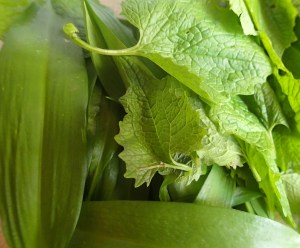
Raw materials

Dinner!
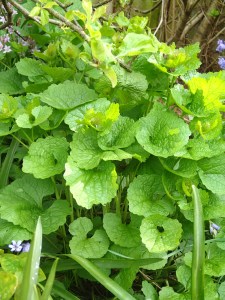
Then, this morning, I was doing a bit of tidying up in the garden, when I found a patch of garlic mustard growing under my apple tree – a welcome addition to the semi-wild area I’m encouraging. I didn’t notice it last year but, then, it’s a biennial plant which take two years to flower so last year’s rosette of basal leaves must just have been less conspicuous.
Interestingly, there is evidence that garlic mustard is one of the earliest plants to be used as a spice in Europe – tiny phytoliths have been found in 6000 year old archaeological remains from Denmark and Germany (Saul et al., 2013). Phytoliths are microscopic rigid silica bodies produced by plants when they take up silicic acid, which have a morphology specific to particular taxa – they can provide evidence about what plants were present, just like pollen grains. Its intriguing to think that, so long ago, hunter-gatherers were interested in plants for their taste as well as just their calorific value.
North Americans, however, are less taken with garlic mustard, introduced as a culinary herb by 19th century settlers. It is now regarded as an invasive weed where, in the absence of natural predators, it has out-competed native plants and become the dominant under-storey species in many areas. While looking for recipes to extend my foraging skills I came across this, subtitled ‘Eat it to Beat it’!

I’m not sure how effective that really is as a control strategy but 13 pages of recipes did inspire me to try a sauce for fried herring for tonight’s dinner!
Saul H., Madella M., Fischer A., Glykou A., Harz S. & Craig O.E. (2013) Phytolith in pottery reveal the use of spice in European prehistoric cuisine. http://dx.doi.org/10.1371/journal.pone.0070583
 heatherkellyblog - travel with me and wonder at what you see!
I must add this to the bunch of odd leaves etc (dandelion, herbs etc) I pick in the garden to go in salads! A fair amount growing down behind the greenhouse I noticed. Interesting that it was important enough as a culinary plant to be taken to North America
Yes – I thought so too!
I expect a Pilgrim lady just wanted to be sure she’d have something to make mustard out of!! ☺️
[…] internet searches led her to an entire cookbook devoted to ridding the world of this one weed (“From Pest to Pesto: Eat it to Beat it”) and I can vouch for the gastronomic qualities of British populations as a […]
Very interesting post and well done for making a wild pesto.
Thanks 🙂
[…] Some of the plants we see are very familiar too – banks of violets in the shade and garlic mustard (see Jack by the hedge). […]
[…] favourite food of Orange-tip butterfly caterpillars, the young leaves also make a great pesto (see Jack-by-the-hedge). I have no need to pick the wild leaves, though, as it has taken up residence under one of my […]
[…] find some scraggy-looking Garlic mustard, Alliaria petiolata, in flower beneath the hedgerows where it has presumably been all summer, hidden amongst other […]
Nice article, Heather.
Would you mind telling me *the recipe you made as a fish sauce* using garlic mustard?? Everyone else on the Internet seems keen on telling you how to make it into pesto. I’ve even seen a bread recipe containing it!! *But no-one seems to want to tell me how to make the SAUCE*, which I’ve heard is traditional, and is used on fish or meats such as lamb. Hence “sauce alone”, I suppose!! Hope you can help me here!.☺️
[…] there will be more Orange tips to come, at least; there is plenty of their favoured food plant, Garlic mustard, in flower by the […]
[…] (unkindly known by some as weeds) have come all by themselves. Wild garlic (Allium ursinum) and Jack-by-the-hedge (Alliaria petiolata), which appeared under the apple tree, provide welcome ingredients for spring […]
[…] On a lunchtime walk through the Botanic gardens with students we found a less fortunate Common Newt, squashed on the path – hopefully it’s an indication that there are others around.I thought I heard lambs as I cycled past East Grange farm on the way to work last week and this week I got to see them, now they’ve been moved to the field near the road with their mums. Tuesday was the first day, too, when there were lots of Dandelion flowers open in the sunshine rather than just a few, bedraggled individuals. Love them or hate them (I love them) they are a very welcome source of food for early insects, including the bees we worry so much about. On my walk up through Cardiac Hill to the department I spotted the first few Wood Anemones in flower and many more leaves, folded up like tiny umbrellas, pushing their way up through the leaf litter. Soon the woodland floor will be covered in nodding white blooms and buzzing with insect life.I was puzzled on a morning run up to Heugh Hall this week to see a newly planted pine tree near the path, only five feet tall, but with mature looking cones. The mystery was solved when I realised the cones were hung on pretty Christmas ribbons. The tree is very close to the gate so I hope whoever went in for this particular bit of guerilla gardening has thought about how big the tree will grow!The spring foraging season has officially started, with lots of Garlic Mustard leaves showing beneath hedgerows and the leaves of the self-seeded wild garlic in my garden finally large enough to enjoy on a pizza. Pesto is next on the list! […]