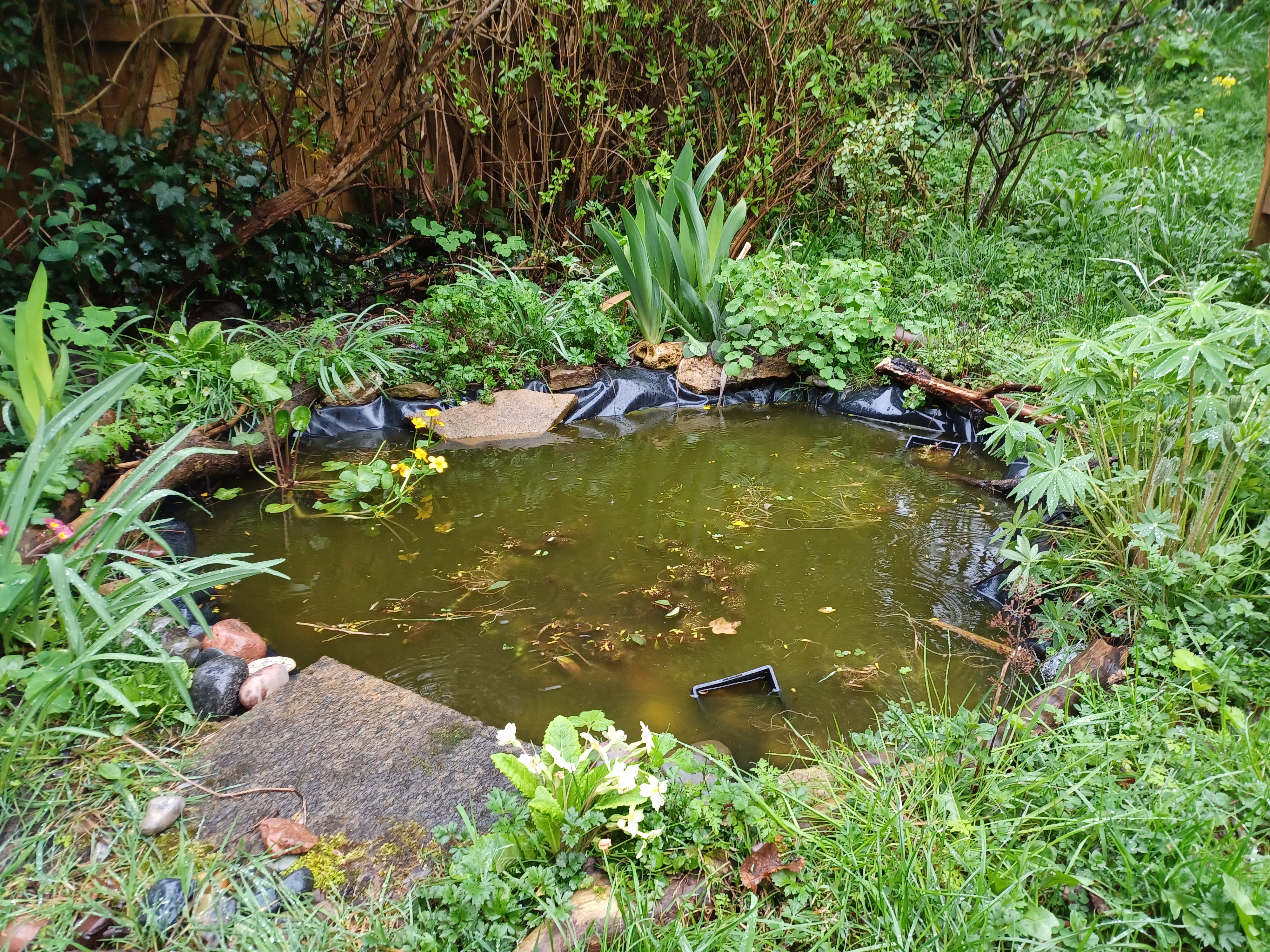
Almost on a par with the excitement of getting our Chinese visas in the middle of March was finding frogspawn in the garden pond we dug last year. The pond is looking nicely established, if a little full of algae, and I’d seen at least one frog in it so I had been hoping there might be a breeding pair…
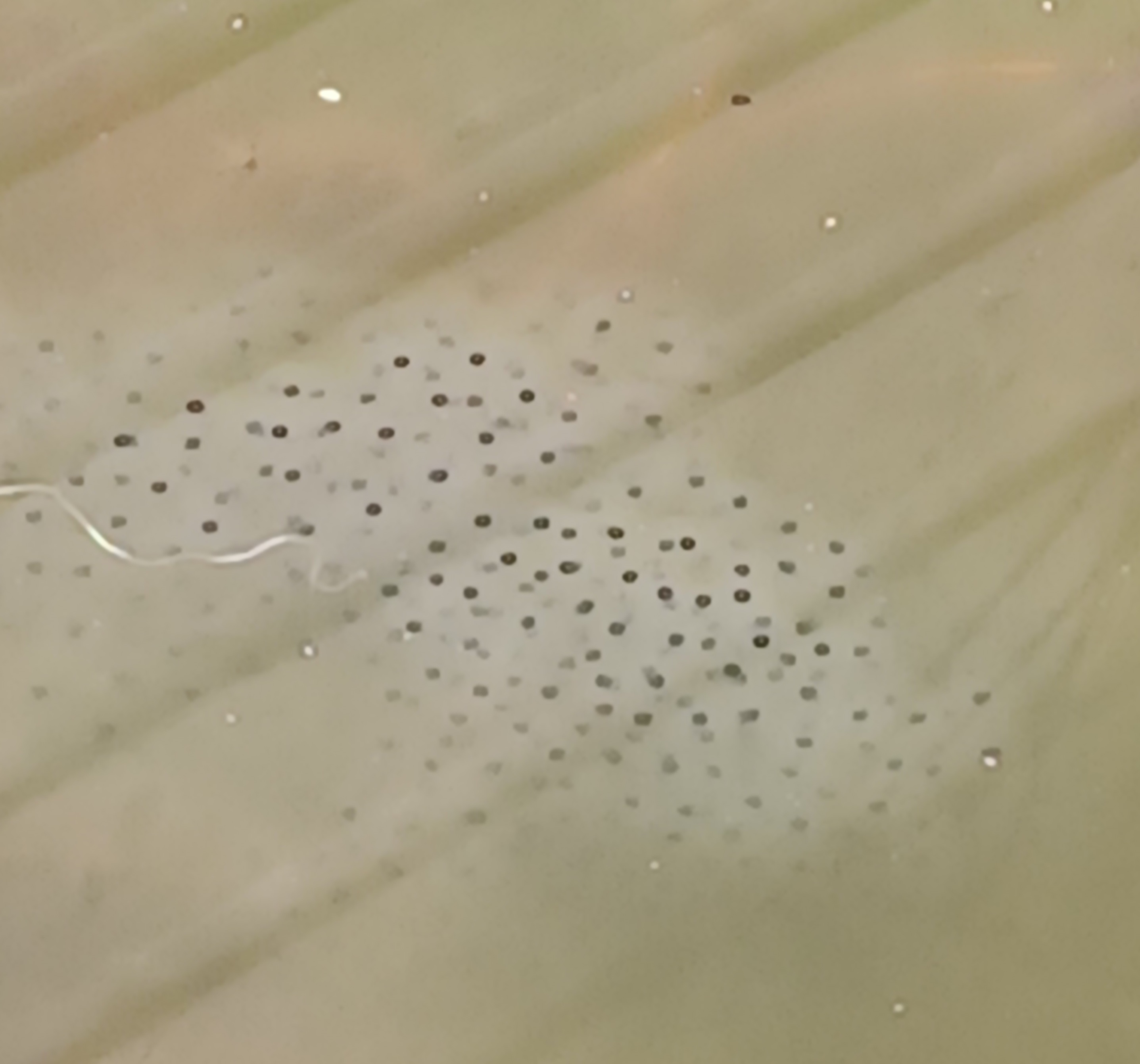
Sure enough, Harry spotted two busy frogs mid March and on the 21st I spotted a bundle of frogspawn. Over 10 days or so the dark spheres (the fertilised eggs) developed into comma shaped embryos, feeding on the paler yolks inside their protective jelly bubbles. The centre of a clump of frogspawn can be several degrees warmer than the outer parts, speeding up the development of the tadpoles within in the same way as alpine plants harness the warmth of their neighbours.
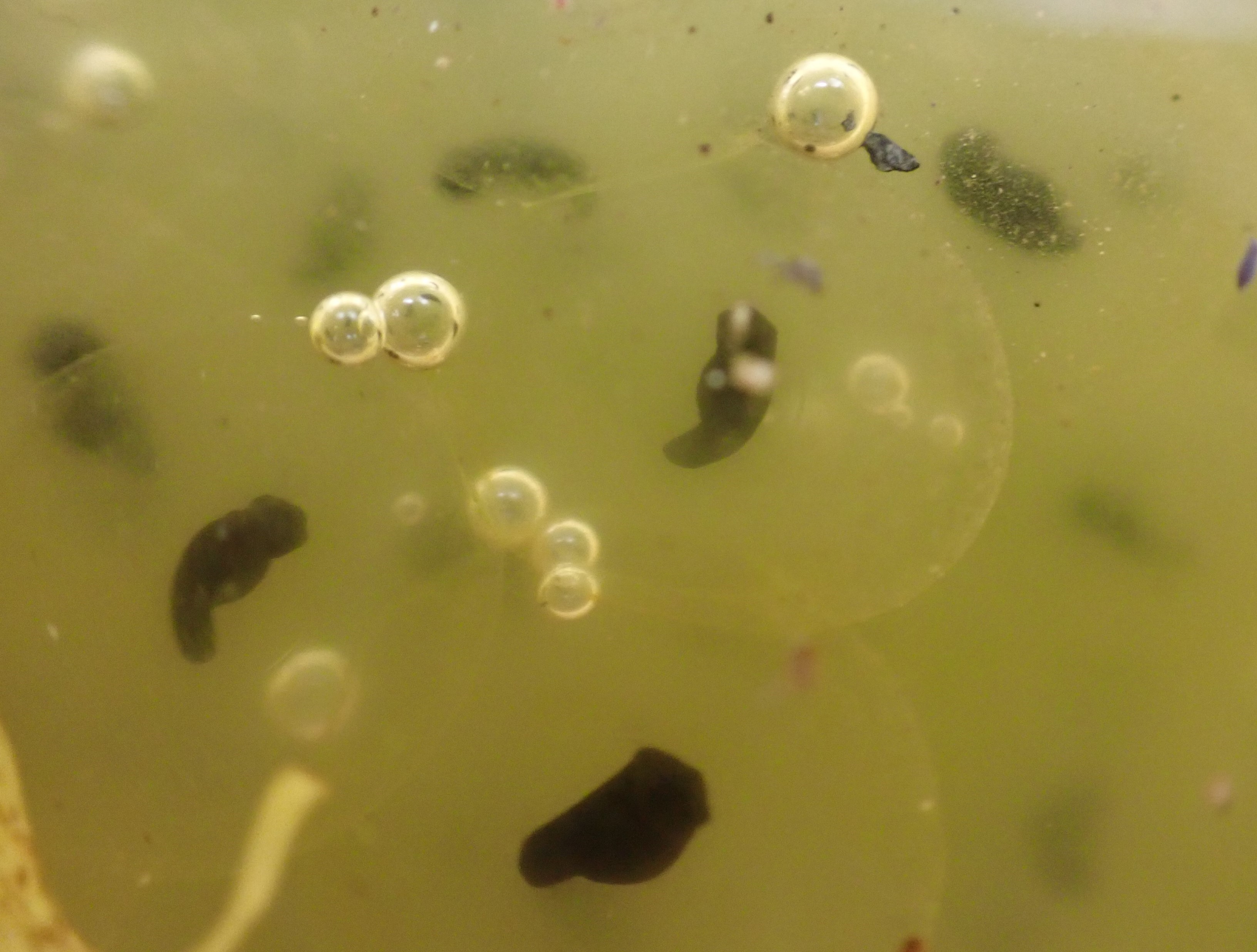
The elongating embryos soon start to move about a little inside their jelly bubbles and, after about 10 more days, they release a digestive enzyme which and allows them to break out of the jelly. Initially the tadpoles don’t have mouths and remain dependent on the remains of their egg yolk so they cluster around the jelly, attached to it by cement secreted for the purpose. When, in due course, the tadpoles develop mouths with rasping teeth, they are able to graze on the film of bacteria and algae which grow on the surface of the disintegrating jelly. In some frog species, oxygen released by the photosynthesising algae speeds up tadpole development. At this stage the tadpoles have feathery external gills to help them absorb dissolved oxygen and functional eyes which allow them to look out for the many sources of danger they face; there is a reason we are not overrun with frogs every year, despite the masses of tadpoles which hatch!

Before we left for China at the end of April I had a quick look to see what I could find in the water. Alongside the algae Martyn has identified, I found plenty of Water Springtails (Podura aquatica), Pond olive mayfly nymphs (Cloeon dipterum), and Mosquito pupae. There were also plenty of largeish protists swimming around – more on those in a later post.


The mayfly nymphs are apparently early colonisers of new ponds, not too fussy about the conditions and, in their larval stage, graze happily on the algae growing on gravel and aquatic plants. Water springtails, in contrast, live on the surface of the water supported by a large, flat tail or furcula and scavenge particles of organic debris. Both should be helping clean up the pond, though it’s still looking quite green!
Currently reading Lessons in Chemistry, by Bonnie Garmus, which came with a strong recommendation from my daughter. She was right, that I’d be really interested in the strong female protagonist, Elizabeth Zott, but for some reason didn’t tell me that rowing also plays a pivotal part in the story…
In the garden, ‘Let it bloom June’ has followed seamlessly on from No mow May – the Red Campion is at its peak and has been joined by lots of White Campion. Around the pond the Candelabra Primulas, Globeflowers and Geum are a picture, though the Ragged Robin I grew from seed is struggling a bit with the competition. I’m now planting out some of the home-grown plug plants from the greenhouse in what was the lawn – lots of Bird’s-foot trefoil, Ribbed Melilot and Greater Knapweed and some precious Small Scabious.
In the allotment I’ve planted out my runner beans and courgettes and both seem to be enjoying the warmth. I’m a bit concerned that none of my potatoes are showing yet – they went in a bit late after our trip to China and we’ve had very little rain since we got home. I’m still desperately hacking back the grass in a vain attempt to stop it flowering.
We’ve been eating stewed rhubarb with an excellent Basque cheesecake as well as Gooseberry crumble cake, made with last year’s frozen fruit. It’s that time of year when I need to think about emptying and defrosting the freezer so there is space for new produce!
 heatherkellyblog - travel with me and wonder at what you see!
Surprised to read that you have mosquito pupae in your pond Heather. Is it not unusual to find them in northern England?
I don’t know, but a friend who’s a freshwater biologist thought that’s what they were. Maybe there are other things that look similar…
I’m sure your friend is more qualified than me!
[…] …”, our garden pond is greener now than it was back in April when I last wrote about it. The frog spawn has hatched into tadpoles but these do not seem to have had the impact that I expected. If anything, based on a quick […]
[…] the most exciting thing of all was the frogspawn which appeared overnight in our pond this week, a full month earlier than we found it last year – spring is very definitely in the air! I’ve just noticed in this photo that you can already […]
[…] hatched into tadpoles now; the jelly-like sacks are empty and tiny tadpoles cluster around them. To start with the tadpoles don’t have mouths and remain dependent on the remains of their egg yolk but, once they develop mouths with rasping teeth, they graze on the film of bacteria and algae […]