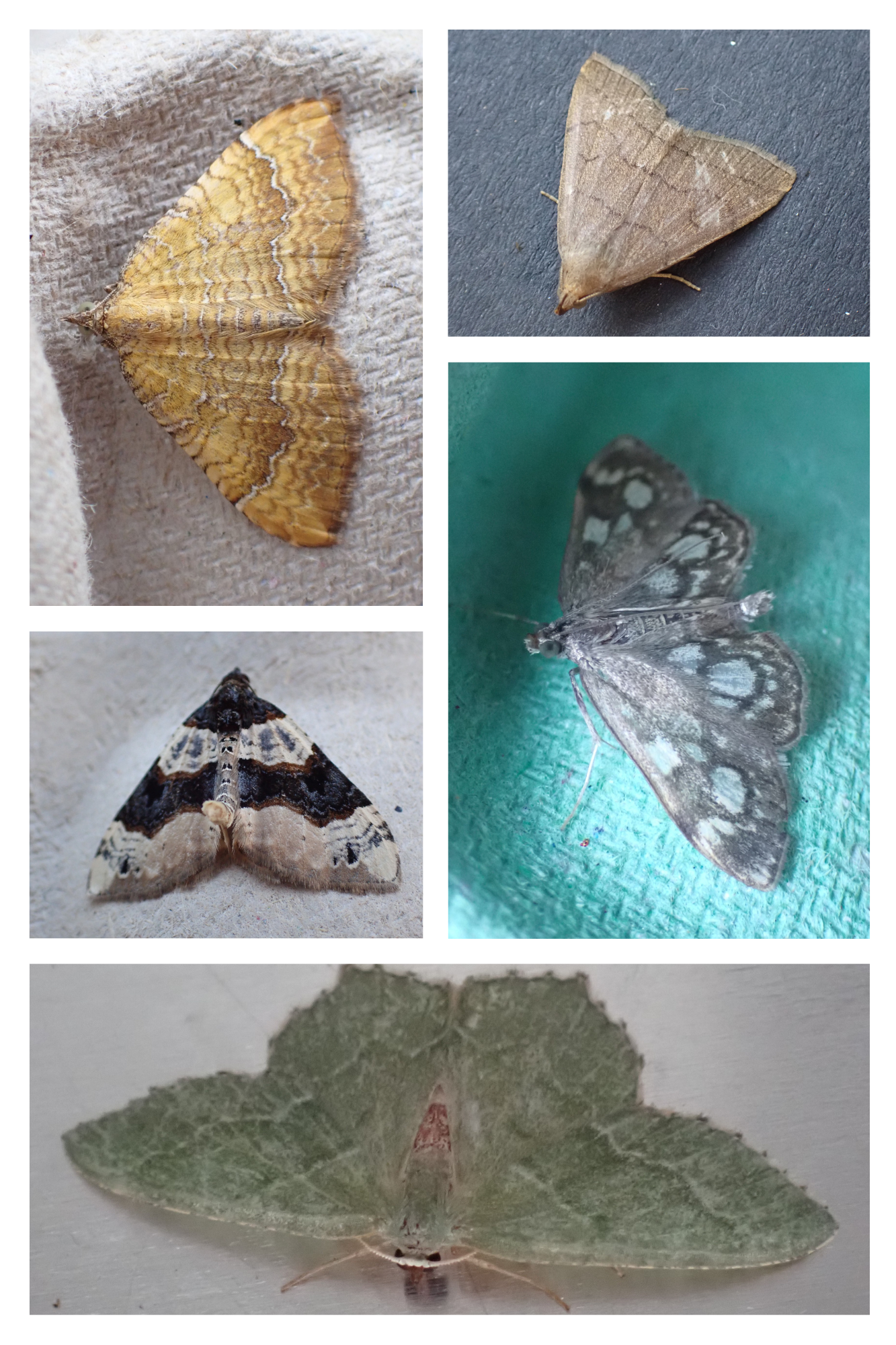
I’m glad to say that, after a few very disappointing nights with the moth trap, I finally got a couple of good hauls this week, both in terms of numbers of individuals and species caught. On Tuesday morning I caught around 20 species of moth and micro-moth, including some new to me. Common Emerald, Hemithea aestivaria, was a lovely surprise. Though not uncommon, I’ve not seen it before; the photo doesn’t do its vivid colour justice. Its larvae feed on the leaves of native woody plants, whilst adult moths visit Wild Privet and Creeping Thistle flowers at night for nectar. Although I have neither in my garden, both are growing nearby. I also caught a couple of Fan-foot moths, Herminia tarsipennalis, whose larvae feed on withered leaves and a pretty Purple Bar, Cosmorhoe ocellata, whose larvae feed on Bedstraws. Elderberry Pearl was a new micro-moth to me – I do find the distinction between micro- and macro-moths a bit arbitrary as the Elderberry Pearl is no smaller than some of the macro-moths which are included in my Field Guide to Moths… Its larvae feed on Elder, Privet, Viburnum and Lilac leaves, all of which are available in my garden!
On Sunday morning I added a male Yellow-tail moth, Euproctis similis, to my garden list – a species whose common name certainly describes it accurately and which is at the northern edge of its UK range in NE England. Its larvae feed on broadleaved trees and shrubs, particularly Hawthorn & Blackthorn. I also found a Magpie moth, Abraxas grossulariata, in my light trap – not a first, but I have seen it more often in my allotment, which is unsurprising as its larval foodplants include Currants, Brambles and Gooseberries!


Casper is learning lots about nature at the moment, including how to find Cinnabar moth caterpillars on Ragwort, but he has yet to grasp that standing shouting at birds or squirrels doesn’t make them appear. One highlight of the week was him standing in the garden shouting, “Bird, Bird,” before ruefully shaking his head and saying, “no birds here,” in the style of the little boy called Buster in Rod Campbell’s lift the flap book, ‘Oh Dear!’ (IYKYK).


We had a day out in York this week, visiting the National Railway Museum with the small train fanatic in our midst and walked round part of the city walls afterwards. The honeyed scent of Buddleia was on the air everywhere and it was great to see beehives in the garden behind York Minster. Even better was seeing that the grass in many of city-centre churchyards had been allowed to grow, providing a haven for biodiversity.

In the garden I have Hollyhocks, Giant Scabious and Helichrysum, all grown from seed, flowering now and in my wildflower areas Betony and Greater Knapweed – a feast for the eyes and for pollinators, I hope!

This week I’ve been reading Another Life, by Kristin Hannah on my phone this week as I’ve discovered I can read and knit if I do that! It’s a compelling story about the importance of our connections with others, be they blood relations or the ‘family’ we choose for ourselves.
 heatherkellyblog - travel with me and wonder at what you see!
Enjoyed reading about the moths but Caspar’s ornithology was the highlight!
On Mon, 29 Jul 2024, 21:03 heatherkellyblog – travel with me and wonder
He’s so funny!
Memories to treasure!
Absolutely!
[…] growing en masse too this week. It shouldn’t have been a surprise, I suppose, knowing that moths such as the Common Emerald feed on them at night. The Buddleia in the garden also smells lovely in the sunshine but there are very few butterflies […]