This has been a funny sort of week, putting away all the toddler toys and kit for another year and catching up with work jobs before our holiday. The week started with the funeral of a very elderly friend, the lovely Joyce Bott. She first crossed my radar many years ago, when I was a first year undergraduate, and she helped run some of our practical classes. Joyce’s husband Martin was an eminent Durham geologist (maybe most famous for working out the significance of the granite underneath the northern Pennines) but Joyce’s full-time career, like that of nearly all women at the time, effectively ended when she married and had children. She was of the generation of women who, though highly talented and motivated, initially missed out on a university education amidst tight competition for places with men returning from the Second World War. Joyce did eventually manage to pursue her interest in science though, against the odds, graduating in Botany from King’s College London. By the late 1950s she was working as an assistant to the phycologist John Lund, at the Freshwater Biological Association in Windermere, where she was a friend of my mum.
Joyce’s path crossed mine again, much later, when she helped out at the university International Women’s Group, which I’ve been involved with since my own children were small. One of the benefits of meeting Joyce again as an adult was getting to visit her fantastic garden – I wish I’d done that more often, over the years. She gardened like no-one else I know, with a fantastic collection of less common plants – up to 25 named varieties of Daffodil and Snowdrop, just for a start. Joyce also turned her scientific skills to breeding new plant varieties of her own, with Delphiniums her particular passion. She bred at least two varieties, including ‘Raymond Lister’, which were awarded the coveted RHS’s Award of Garden Merit (AGM) – a very unusual achievement for an amateur breeder.

What I didn’t know about Joyce was that she also kept a diary right until the end of her life, reflecting on the wonders of creation. It was lovely hearing some short excerpts from that read by her daughter Jacqueline at her funeral, giving a real sense of the Joyce we knew and loved. I’d love to hear more from anyone with their own memories of Joyce.
Around Durham, things are starting to look distinctly autumnal this week but it is great to see the native wildflowers planted outside the Bill Bryson library looking so well established. Wild Carrot, Yarrow, Ladies’ Bedstraw, Ox-eye Daisies and Knapweed are still in flower, whilst other plants are now setting seed, hopefully securing next year’s meadow.

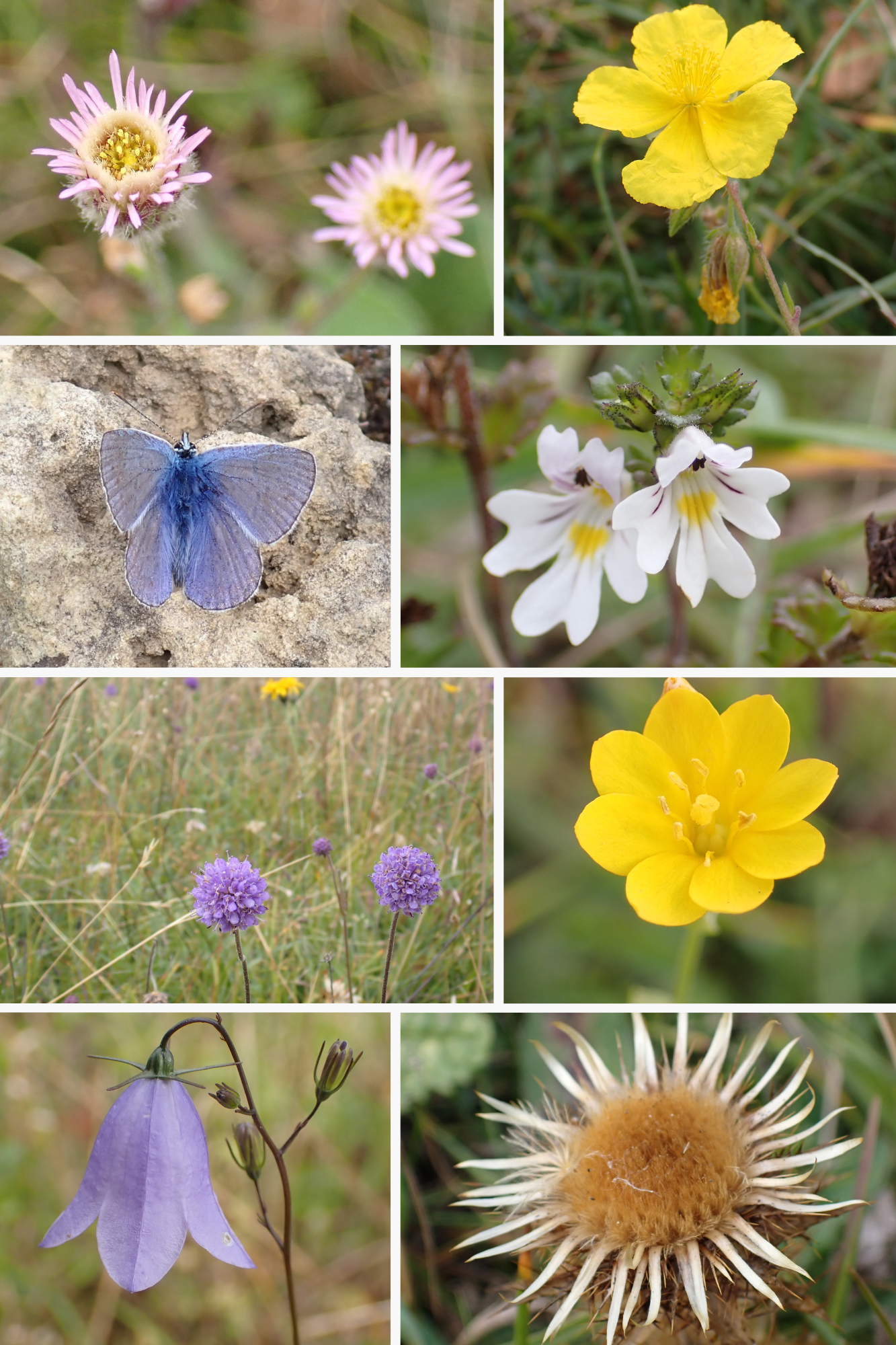
More of a surprise was finding Blue Fleabane growing as a pavement plant in the village! I associate it with the lime-rich grassland of our local quarry nature reserves and, indeed, we found it later in the week on a mooch round Bishop Middleham and Thrislington. I’d feared most of the flowers would be over but there were many lovely things still to see. Both sites are full of Devil’s-bit Scabious at the moment, with Common and Small Scabious still very much in evidence. Lots of bees and some Wall Brown and Common Blue butterflies were enjoying a last hurrah, and a Buzzard circled above us at Bishop Middleham. We were too late for the Dark-red Helleborines, but it was good to see plenty in seed – it must have been a good year for them.
Saturday morning saw us on a fascinating city walk in Newcastle led by Kieran, of the North East Heritage Library – a ‘Deep Dive Urban Safari’ into the local history of the east end of the city. Who would have thought that there was so much to learn from old pillar boxes and drain covers?! Kieran did an amazing job of helping us peel back the layers of history and think about how different the city would have looked even a couple of hundred years ago. The story I liked best was about how the many deep denes running down to the River Tyne were modified to make it easier for people and goods to move in and around the city in horses and carts. One example was a section of the Ouseburn which, in the early 20th Century, was put into a culvert below the area known as City Stadium and then infilled with rubbish, to reduce the gradient of the hills. The moniker comes from the fact that some bright spark thought this unstable land would be a great place to build a 95 000-capacity, three-tiered stadium for the Toon football club, despite the fact that noxious gases from the decomposing waste still have to be vented today. Fortunately sense prevailed! City Stadium is now home to some allotments and a park with an attractive strip of native/pollinator-friendly flowers such as Greater Burnet, Knapweed, Mallow, Common Toadflax, Bedstraws and Verbena. The danger of subsidence turns out to be a surprisingly important factor in preserving much of the green space around Newcastle city centre – it’s an ill wind which blows no-one any good!
In the allotment I’ve finally start some hedge cutting – the self-seeded hawthorn saplings I transplanted along the fence some 10 or 15 years ago are now a thick, unruly hedge which is continually threatening to get out of control and completely cut the light from parts of the garden.
 heatherkellyblog - travel with me and wonder at what you see!