I think it’s time to break the nature-focussed pattern for now as we’ve just started a fortnight’s holiday in Tunisia – partly chosen to give me a chance to practice the Arabic I’ve been learning, slowly, over the last four years. It’s not that simple, though, as most people’s first response on seeing a European is to speak French to them and, obviously, to address the man… Our first couple of nights were spent in the sleepy seaside village of Hergla (هرقلة in Arabic) and the confusion starts here – there is no letter ‘G’ in Arabic, where the name would be pronounced Harqala, so I have no idea how this became the transliteration!
Our arrival in Hergla was not entirely stress free – first our credit card wouldn’t work in the car hire man’s machine and we had to get money out from the cashpoint at the airport to supplement the cash we’d changed on arrival, and then Martyn’s e-sim card wouldn’t work so we had no way of navigating to our AirBnB apartment once we reached the village. Miraculously, the restaurant owner we approached to ask if we could use his WiFi turned out to be our host, Bannour! Not only that but he went on to cook us the most amazing dinner, despite the late hour.

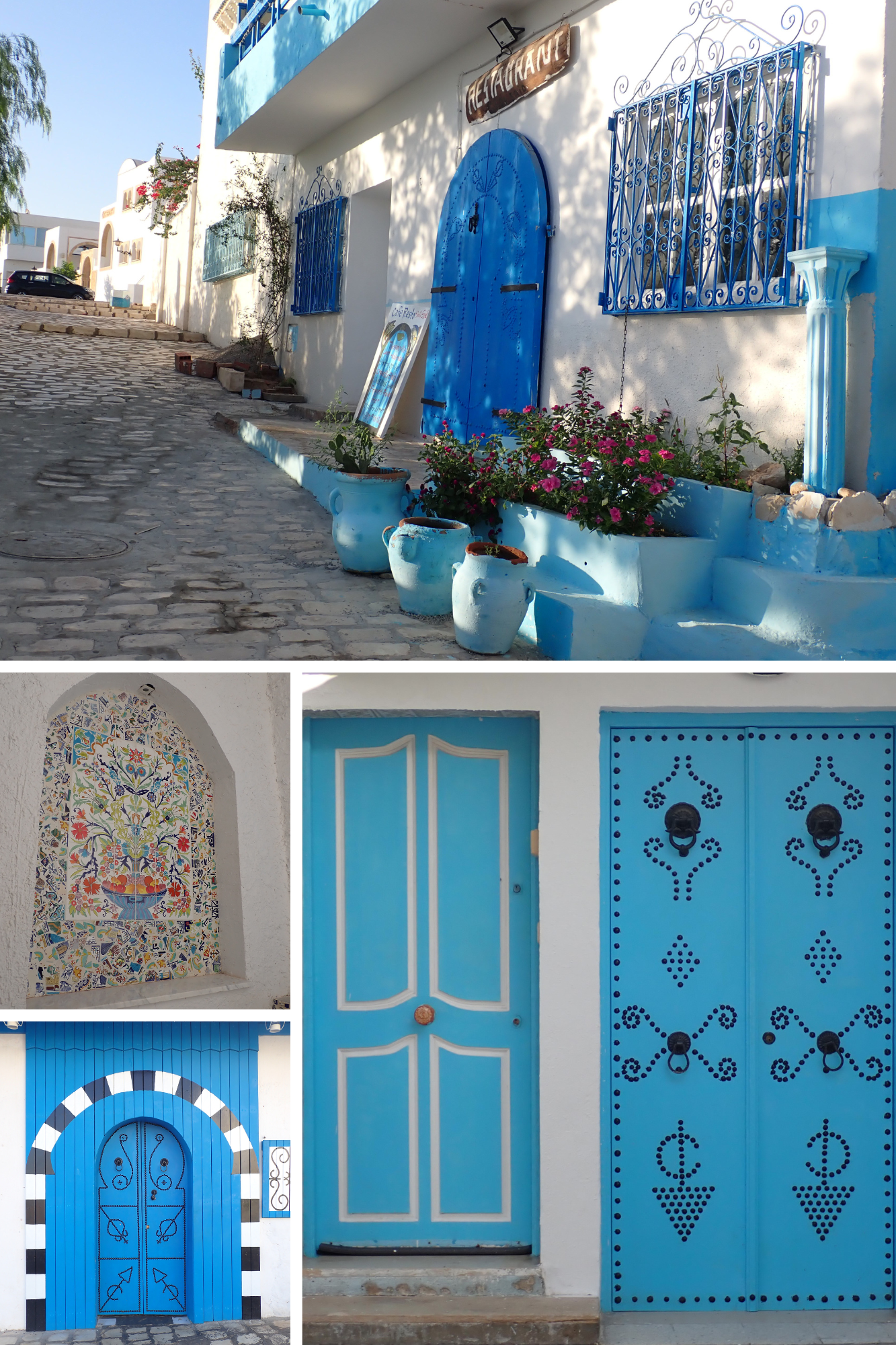
Hergla turns out to be a tiny place but very pretty, with virtually no sign of tourists or their infrastructure – the perfect place to ease ourselves gently into a very different culture, wandering around the backstreets and enjoying the light and colour. One surprise has been the preponderance of boulangeries making excellent French bread and pastries rather than flatbreads, though we’ve enjoyed traditional Berber tabouna, with black onion and fennel seeds, for sandwiches.
Hergla has a working fishing port rather than a picturesque one but the beach was disappointing, looking very neglected and full of rubbish. Not without interest for Martyn, though – the furry brown balls covering it turn out to be an alga called Chaetomorpha linum which form a felted mass when the algal filaments break off from their substrate and get rolled around in the waves. More on this for algal geeks on Martyn’s blog.
My own bit of geekiness always involves looking at obscure plants but it’s not the best time of year for that in North Africa – nearly everything has finished flowering. There are at least two types of purple-flowered Solanaceae still flowering though, one going by the moniker of ‘Devil’s Apple’ or Apple of Sodom’, presumably because its tempting looking fruits are highly poisonous! Both species have golden, tomato-like fruits but those of S. cornutum (Yellow Nightshade) are much smaller, only a cm or so across.

There is lots of thistledown in the air from enormous thistles growing everywhere on waste ground – they are almost Cardoon-sized but difficult for me to identify just from their seed heads. I’m thinking maybe Carduus macrocephalus, on account of their size and distribution, but no guarantees, I’m afraid.

The other dried plants in evidence everywhere are piles of leaves of esparto grass, Stipa tenacissima, known as Halfa in this part of the world. They are woven into everything from sun- and lampshades to baskets and frames for mirrors, though the hairy lampshades are, I feel, an acquired taste!

The culinary highlight of our time in Hergla was probably the meal Bannour cooked for us, with little appetizers known as kemia, fresh salads including the local mechouia made from grilled peppers and fish grilled over coals in front of us – it couldn’t have been tastier. Our second dinner, at the Restaurant l’etoile overlooking the sea, ran it a close second though and we got to try the local speciality known as a briq here too – a thin fried pastry stuffed with potato and an egg. The friendly host seemed pleased with my attempts to order in Arabic and he at least played along!
I’m currently reading Tremor of Forgery, Patricia Highsmith’s thriller set around Tunis in the 1960s, for a bit of historical context.
 heatherkellyblog - travel with me and wonder at what you see!
Some more historical context: https://www.amazon.co.uk/TANIT-Lost-goddess-Central-Mediterranean-ebook/dp/B0DBHTQST4
Thank you