This last week has seen the beginning of meteorological winter at the start of December, as well as the start of Advent, but wintery weather finally came to these parts a fortnight ago, after an unseasonably-mild start to November.
Before the weather turned I squeezed in another walk in the Botanic gardens with a student and we found a delicate pink Slime mould growing on fallen wood, as well as the more commonly spotted ‘Angel’s bonnet’ mushrooms. I’ve written about plasmodial slime moulds before, with their fascinating, multi-stage life cycle. Whilst they used to be classified as fungi, we now know they are amoeboid protists, with cells which can swarm and come together to form search for food and eventually produce new, stalked sporangia, like those we found.


The weather was mild for my regular trip to Kirkcudbright mid-November and the beech trees along the way looked stunning, though most of the other leaves have gone. On an early drive home I spotted a Roe deer grazing just by the A75 – hopefully it had the sense to move further from the road when the traffic built up. The mild weather meant Nasturtiums and Ivy-leaved Toadflax were still flowering on walls around the town and grass was emerald green and clearly growing. I always enjoy the bird life in that part of the world; there are not many places you can see a Red Kite soaring above the garden and, walking along the river into town, watch Curlew, Oystercatchers and other small waders feeding on the mudflats at low tide.
Later in the month the Botanic Gardens looked very different, after a few hard frosts. But I was intrigued to notice that, even after a hard frost, the ground beneath the leafless trees was green and frost-free – as if the tree was protecting it somehow. A little digging (metaphorical) revealed that this is indeed the case. When the air temperature drops at night, water vapour from the air condenses out onto objects close to the ground. For most of the year, this is what we call dew but, if the temperature is low enough, the water freezes and forms ices crystals (frost). Trees, like every living organism, emit a little heat and some of this is directed towards the ground rather than lost into the sky so the ground under the tree stays a little warmer that elsewhere, keeping it frost free at least until the temperature drops further below zero.
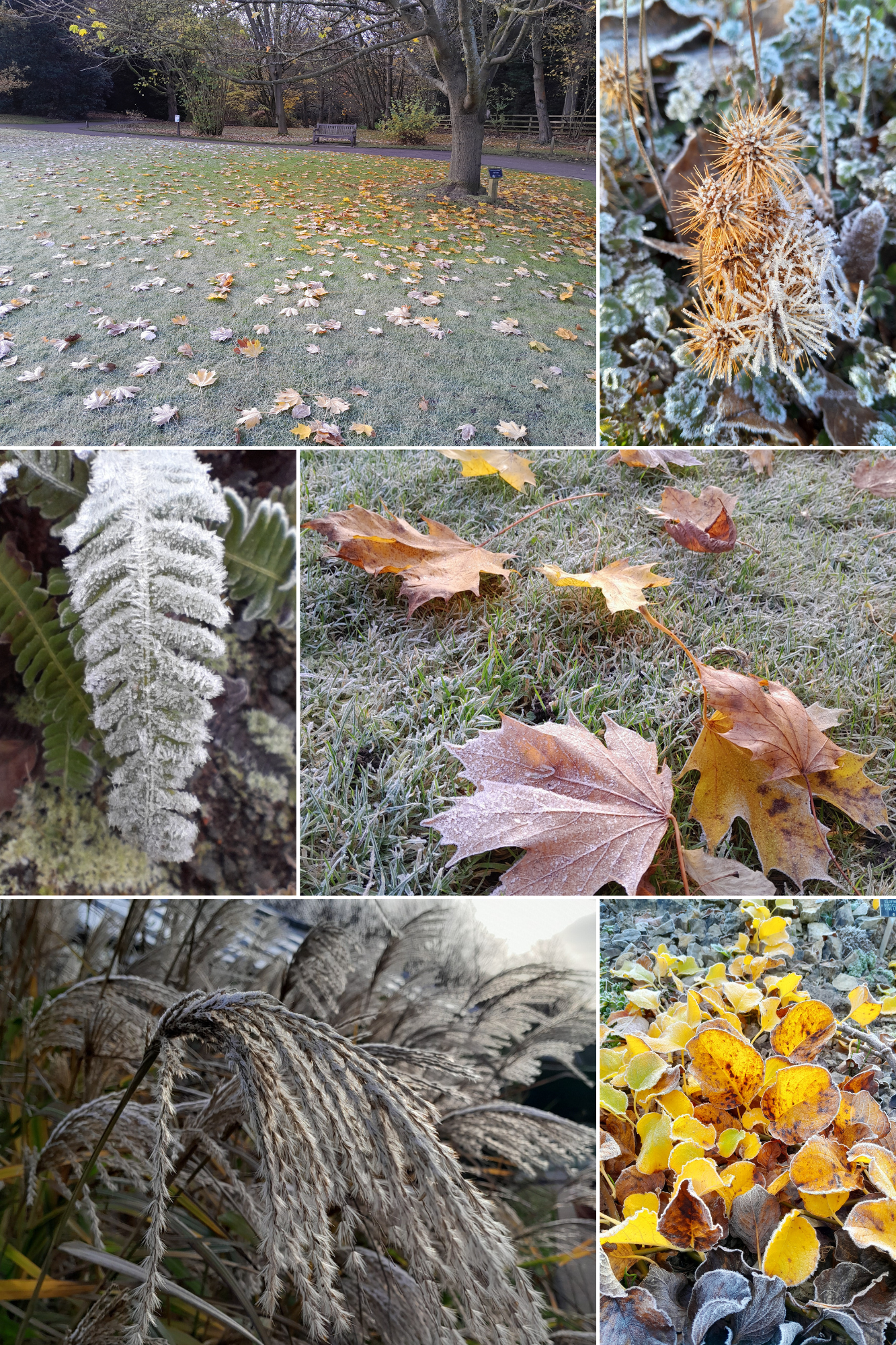
Other than that, it’s been another ‘head down’ couple of weeks, with limited time outdoors even when the weather has been tempting (and it’s often been far from that). One thing I do love to see at this time of year is the catkins on Hazel trees already preparing to shed the clouds of pollen which will mark the start of a new season of growth. The lack of leaves on the trees also makes small birds more visible as they flit around, both in the garden and when I’m out and about. You have to go for small wins on damp, dull winter days!
I listened to The Bell Jar, by Sylvia Plath on my trip to Scotland, wanting to know more about this troubled woman. Largely autobiographical, the novel starts out as a vibrant account of what it’s like to be a young woman from small town America given the chance of an internship in New York, but soon spirals into something much darker. The heroine, Esther, breaks down under the pressure to conform (under the bell jar) and spends much time pondering how to take her own life. The whole thing is made unbearably poignant knowing that Plath took her own life just a few years after finishing the book, at the age of 30.
I’ve also been reading The Future by Naomi Alderman, an entertaining but thought provoking tale, set in the near future, about a group of activists who decide to challenge the power of those who control the media and the narrative about economics and climate change, for the good of the planet. It’s full of intriguing plots twists which keep you hooked and there is something good about seeing a thinly-veiled version of Elon Musk get his comeuppance!
The garden hasbeen full of slightly confused plants in flower – Mahonia and Winter Jasmine shouldn’t really bloom until January and Marsh Marigolds till March but here they are, in mid-November. Their flowering must be linked to both temperature and daylength and they obviously don’t need a period of chilling or vernalisation to set them off. And the roses I cut back have also produced a flush of late flowers.

In the allotment, at the beginning of the month it was still warm enough for me to spend time cutting back my hedge and bramble patch. I was amazed to discover a few bunches of small and rather sour grapes sheltering against a south facing shed wall. Most years the vine is only good for its leaves this far north!

 heatherkellyblog - travel with me and wonder at what you see!