Our first weekend in China was the Tomb Sweeping (Ching Ming) festival, held every year on the 15th day after the spring equinox, and we spent it with Kate’s parents in their grand apartment in An’yue, an hour or so’s drive SE of Chengdu, and in the hamlet near Shi Yang Zhen, an hour or so beyond that, where her father grew up in a large family, in grinding poverty, in the 1960s and 70s. It was a slow drive; a huge proportion of Chinese people have moved to cities in the last generation, so the family tombs which need to be visited this weekend to show respect to their ancestors are in rural areas, accessible only by narrow roads once you leave the narrow highways.
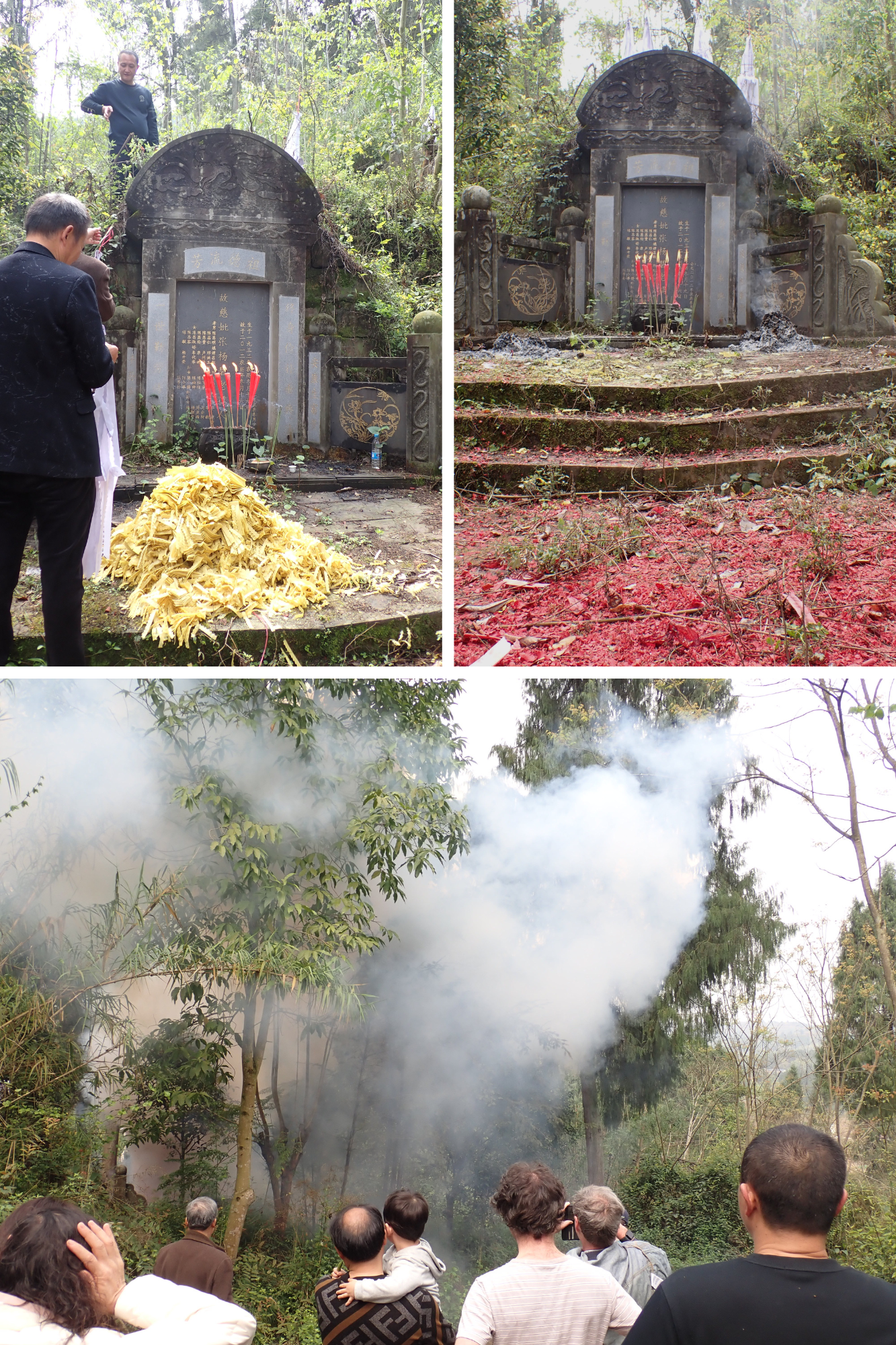
Venerating your ancestors is important when you believe that their spirits carry on living in the natural world and can influence your own fate. Honouring them with incense and burning generous offerings of spirit money so they can purchase luxuries for the afterlife should make them well disposed towards you. It certainly hasn’t done Baba Chen any harm! We called in at Kate’s aunt’s shop on the way to buy incense sticks, a stack of paper money and an enormous reel of firecrackers.

Kate’s grandparents and other ancestors have tombs on the wooded hillside above the village, so we walked up the hill with several of her aunts and uncles. When people warned us to stand well back, they were not joking. Kate’s father lit the incense sticks, set fire to the paper money and set off the firecrackers, which made a truly ear-splitting racket! The firecrackers are supposed to both to scare away evil spirits and to alert the ancestors that their descendants have come to pay their respects. Fortunately, the noise lasted a few seconds, but we could hear explosions from nearby tombs reverberating around the valley the whole time we were there. Tomb Sweeping does seem to be a bit of a misnomer as the debris left behind after the ceremonies is quite something, but maybe that is what has to be swept up before the next festival!
Afterwards we carried on to a small Buddhist shrine at the top of the hill, before joining the extended family for a meal in the new house which stands near the one where Baba Chen grew up. The changes in his lifestyle over just a generation are hard to comprehend and are repeated everywhere in this vast country.
Of course, one of the best things about being in the countryside was the chance to be in a more natural environment and it’s a delight to me to see how much Casper loves it and how interested he is in everything around him. The family holidayed in Bali over Chinese New Year and he talked about it constantly; “You been to Bali Dau (island] Brandma? I take you”! He takes every opportunity to collect seeds, leaves and sticks even in urban environments, carrying them around as trophies. Walks are slow because any kind of insect or small creature needs close investigation – he was thrilled when a dragonfly landed on their 25th floor balcony and sweetly concerned about where its Daddy and Mummy were. He’d have happily spent hours looking at the fish, tadpoles with legs and tiny froglets in Renmin park and at least as interested in the bug hotel and why there were no butterflies in it as in the Giant Pandas, when we visited Chengdu’s world famous Panda breeding institute.

An’yue county is most famous for its lemons and many Buddhist stone carvings. On this trip we visited the caves at Pilu, near Shi Yang Zhen, with their beautiful Song dynasty (960 to 1279 AD) Shuiyue Guanyin, known as the Oriental Venus de Milo and also the grove of the Reclining Buddha or (Wofo Yuan) an hour or so NE of An’yue. As well as the enormous Tang dynasty (618-907 AD) reclining Buddha, guarded by a ripped-looking warrior, the grove contains a huge collection of Buddhist texts carved into the stone walls of a series of caves.


Like all tourist attractions set in scenic areas, the grounds are very manicured, planted with tidy shrubs and flowering plants, including the ubiquitous Iris japonica. Despite that, though, a few ‘weeds’ show their tenacity – Forget-me-not-like Trigonotis, Mazus pumilis, delicate Androsace umbellata and, in damper spots, Maidenhair ferns and lots of mosses and liverworts.

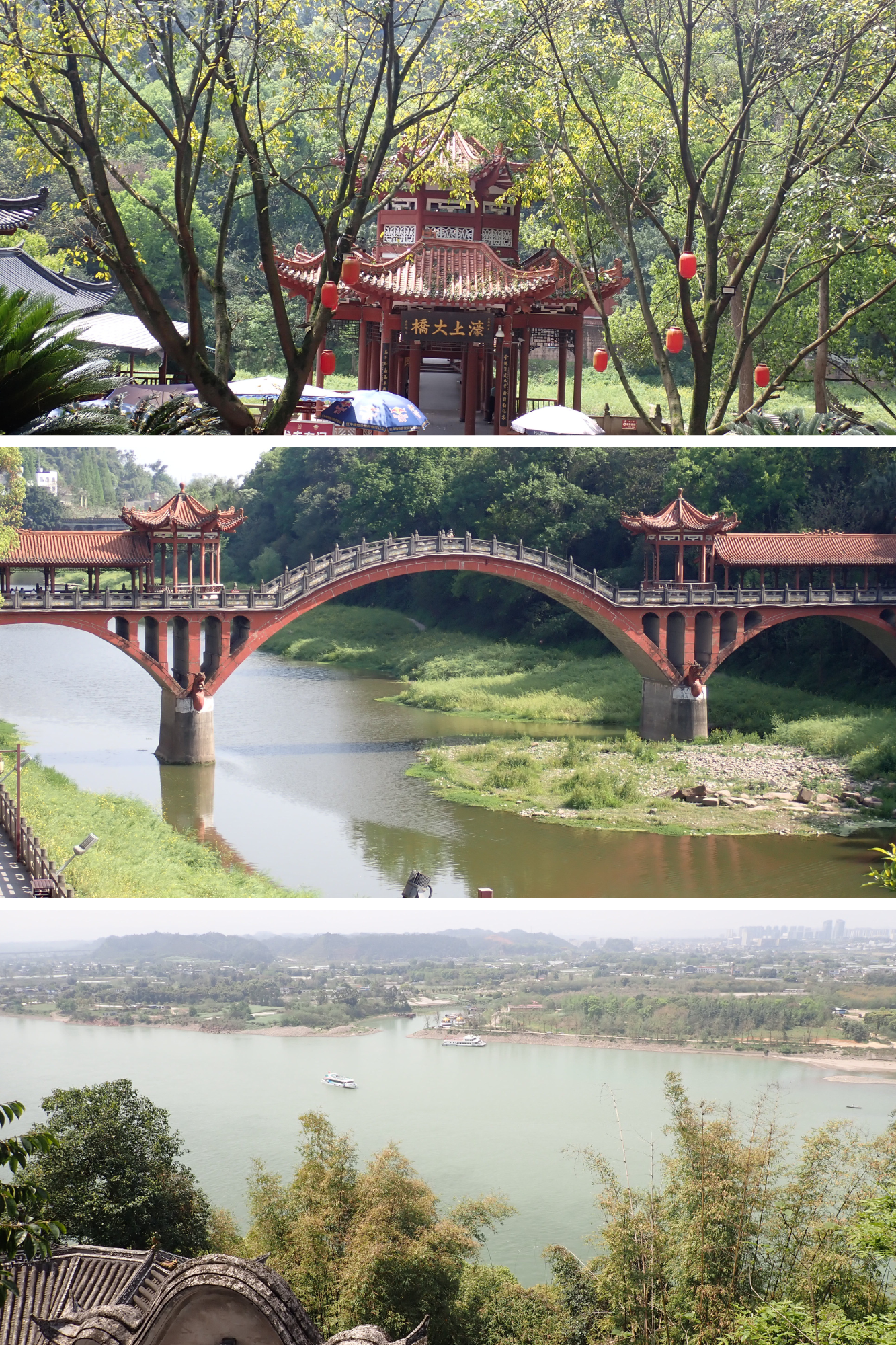
The following week we made a day trip with Harry and Casper to see the giant Buddha at the confluence of the Qingyi, Dadu and Min rivers, near Leshan, set in the rather wilder Mount Emei scenic area and World Heritage site. The giant Buddha and several smaller ones around the site were carved from the red, Carboniferous sandstone of the cliff face above the confluence in the 8th century and the paths around the site involve lots of steps. The 71 m tall Buddha, the largest in the world, is undoubtedly impressive but I preferred the subtle landscape carvings in some of the caves. The Guanyin statues here have many, many hands, apparently so they can be as helpful as possible! Mount Emei has great cultural significance, as the site where Buddhism first became established in China, before spreading eastwards, and the first Buddhist temple in China was built on its summit in the first century AD. Now there are more than 30 temples in the surrounding area. We visited some but not all, including the Wuyu temple on the far side of the river.


The wider Mount Emei site’s World Heritage accreditation is also partly due to its conservation status, as a place with exceptionally high floral diversity, lying at the junction of the Sichuan basin and the eastern edge of the Himalayas. According to its citation, Emeishan is home to 3200 plant species, 100 of them endemic and 31 nationally protected. This biodiversity is found well beyond the tourist area on the Qifen Peak of Lingyun Mountain where the Giant Buddha itself sits; the citation describes an elevation range of 2 600 m, from subtropical evergreen, broad-leaved forest (where we were) to sub-alpine conifers. Although we needed a little judicious bribery with ice-cream to encourage Casper to walk at least some of the uphill stretches, we certainly didn’t gain this much height! Maybe if I can help maintain his interest in plants and wildlife Casper and I can some back when he’s older and explore the mountain itself….
 heatherkellyblog - travel with me and wonder at what you see!
[…] coals to Newcastle, as I should have learned from last year when we were in the countryside for the Tomb Sweeping festival. And as for cracker jokes, they lose the little merit they have when you need to explain them word […]