One thing we wanted the students to learn about in Switzerland is the process of primary succession, in which newly-exposed bare ground is gradually colonised by successively larger and more complex vegetation as soil develops to support it. In the UK, the only place to see anything approaching this is at the coast, where new sand dunes are forming and being colonised, but here we are just a few miles from Morteratsch, the largest glacier in the Bernina alps. As glaciers retreat, which all are doing as our climate warms, they leave behind a perfect experimental setup to study succession. We want to make the most of this, as well as helping the students see the effects of climate change for themselves.
20 000 years ago, during the most recent ice age, the whole of the alps was covered in an ice sheet. This gradually melted as Earth entered an interglacial period, leaving behind Lakes Zurich and Geneva and those in Northern Italy. The remaining ice was trapped as glaciers in the highest mountains. These glaciers grew larger when the annual temperature fell and retreated when the temperature rose. Two stops up the line from us in Pontresina is Morteratsch station, built in the late 19th century to transport tourists to the then foot of Morteratsch glacier. In 1860, the glacier reached its most recent maximum during the ‘Little Ice Age’ in Europe and the people of Morteratsch village prayed that the ice wouldn’t expand any further, for fear it engulfed their homes. With their typical efficiency, however, the Swiss have been measuring their glaciers since 1878 so we know that Morteratsch has been in retreat since then, at an average rate of some 18 m per year (much faster than that currently). The snout of the glacier, which was once close to the station in 1878, is now more than three km up the valley.
Helpfully for us, the location of the snout over the years has been marked by a series of information posts as you walk up the valley, from its maximum length in 1860 to its 2023 position. Initially these posts are set at 20 year time intervals but, as the speed of retreat increases, they are only five years apart. Our visit last Sunday, to recce the site, was cut short by driving rain which set in around 1960. We persisted as far as 2015, where the trail crosses the river which flows from the glacier, but didn’t fancy the steep scramble over wet rocks to the snout itself.

We were much more fortunate when we visited with the students this week. With wall-to-wall sunshine forecast we decided to walk all the way to the glacier snout first, before making our way slowly down the valley, sampling the vegetation at regular intervals to see succession in action. Being close to the snout was a first for all of us – an awe-inspiring experience but also a sad one, wondering whether this will be something the student’s children will get a chance to see. We speculated how long the air bubbles trapped in chunks of ice fallen from the glacier have been there and the students proved that the urge to throw stones into water persists long beyond childhood as we had prised away from the water to start work!

Our first quadrats were laid out around 160 m from the current snout of the glacier, where we estimated the snout had been in 2020 – sobering in itself. Most of the ground was bare here, with very few of the lichens I’d expected, maybe because they grow so slowly and new ground is being exposed so rapidly. There were lichens such as Stereocaulon and Umbelicaria (Rock Tripe) on bare rocks further down the valley, where they’d had more time to establish themselves. However there was more other vegetation this close to the snout than I’d expected – Fleischer’s willowherb (Chamaenerion fleischeri), Tamarisk (Myricaria germanica) and Purple Willow (Salix purpurea) as well as Rachomitrium moss and Tufted hair grass (Deschampsia cespitosa). The grass and Willowherb are certainly ruderal species, which produce large numbers of tiny seeds which disperse widely, so they are capable of spreading rapidly only any bare ground, but there must be a little soil developing in cracks and crevices for them to flourish.
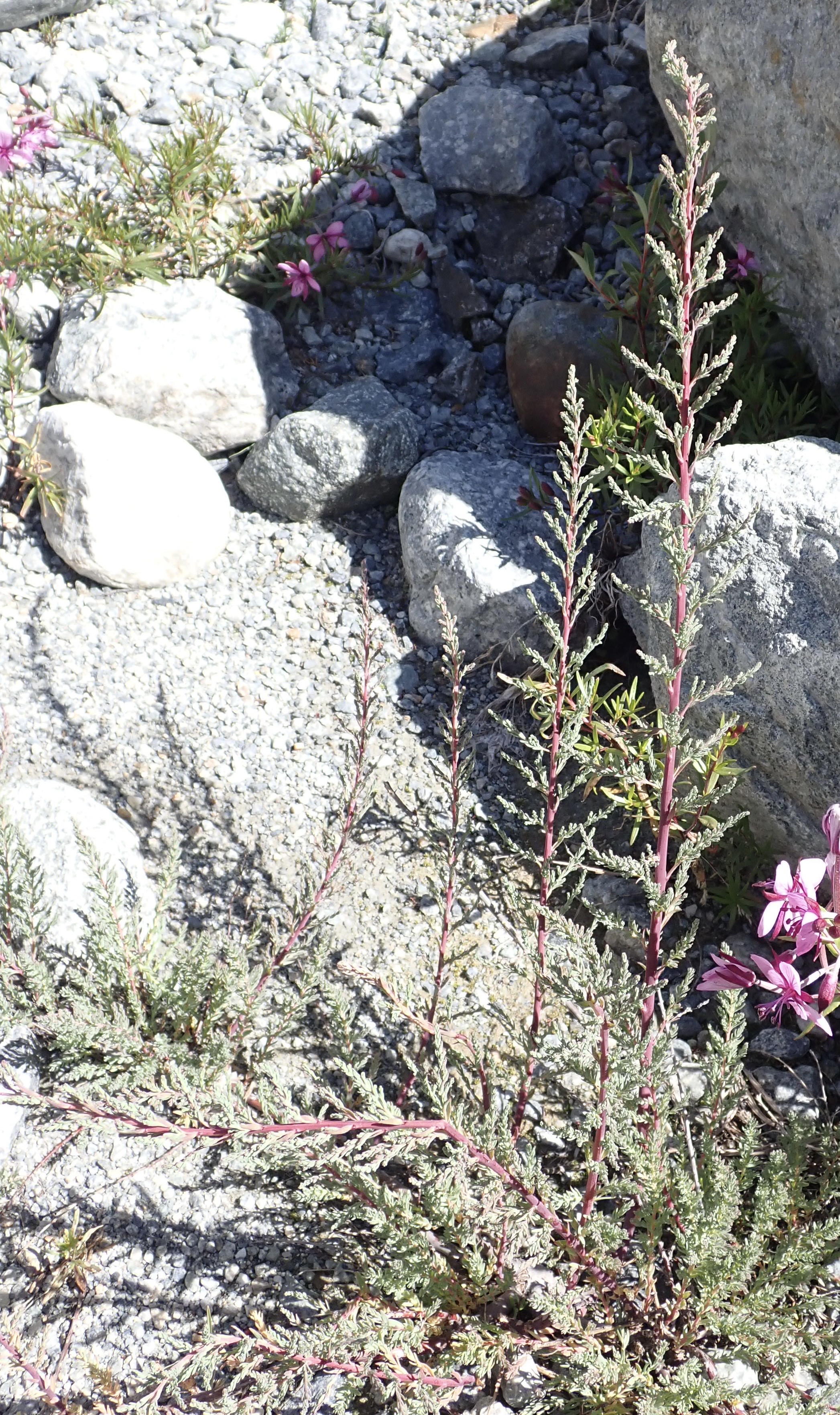


As we walked down the valley, we saw the vegetation gradually change. First of all, at around 600 m from the snout, a larger variety of small herbaceous plants such as Mountain Sorrel, Sempervivums and Saxifrages appeared, followed by an area with more small, shrubby vegetation. The Sempervivums are plants well adapted to harsh conditions, particularly high UV levels and a shortage of water. They are succulent plants which use CAM, a special type of photosynthesis where the stomatal pores open at night rather than during the day, to take in carbon dioxide, and then store it as organic acids in the cell vacuoles. During the day, with the stomata closed to conserve water, light energy is then used to convert these organic acids into the sugars and starch necessary for plant growth. The Cobweb Houseleeks at Morteratsch have a couple of additional survival features; the red colour of the flowering shoots and leaves indicates that they are full of carotenoid pigments, the plant version of sunscreen which protects the photosynthetic process from the effects of excessive light and UV radiation. The network of fine hairs over the leaf rosettes, which gives the plant its common name, adds the belt to the braces by protecting the most vulnerable part of the plant, the dividing meristem cells necessary for growth – the hairs diffuse intense light rather as a layer of clothing protects our skin.


The shrubs a little further down the valley include a variety of small Willow trees, which are hard to identify to species level but are clearly different from one another, as well as Green Alder, Alnus alnobetula. Both Alder and Willow cope well with damp, which this area certainly is when the snow melts in spring, and we speculated that the flexibility of willow stems might help them survive in exposed sites and under a blanket of snow. Alder trees have another helpful trick up their sleeves – like many plants in the pea family (Fabaceae) they can use nitrogen from the atmosphere, with the help of bacteria which live in nodules on their roots, so are much less dependent on what is available in the young, thin soils here. Alder use Frankia bacteria rather then the Rhizobium which pea family plants harbour, and produce larger more knobbly nodules, but the process is otherwise very similar.


The students’ results showed an average one percent annual increase in herbs and forbs down the valley, along with a 0.5% annual decrease in bare ground in the area we surveyed, which represented the 100 year period from 1920 to 2023. By the time we reached where the snout was in 1960, shortly before two of the staff on the trip were born and around two km from the current front, there was significant, if patchy, tree cover of Larch (Larix decidua) and Arolla Pine (Pinus cembra). The trees get larger and their density greater from here to the station, reaching something like the climax vegetation for the area.
After the students do their ID test today we’ll be heading up in the cable car to our highest point of the trip, Diavalezzo, at around 3000 m, where we’ll be able to look down on both Morteratsch and Pers glaciers, so we really have had a 360 degree experience of the glacier, in all its moods.
 heatherkellyblog - travel with me and wonder at what you see!
[…] ago. It’s also perfect for seeing succession in action at the foot of the rapidly retreating Morteratsch glacier and both staff and students had a great time and learned a lot. However, being immersed for nearly […]