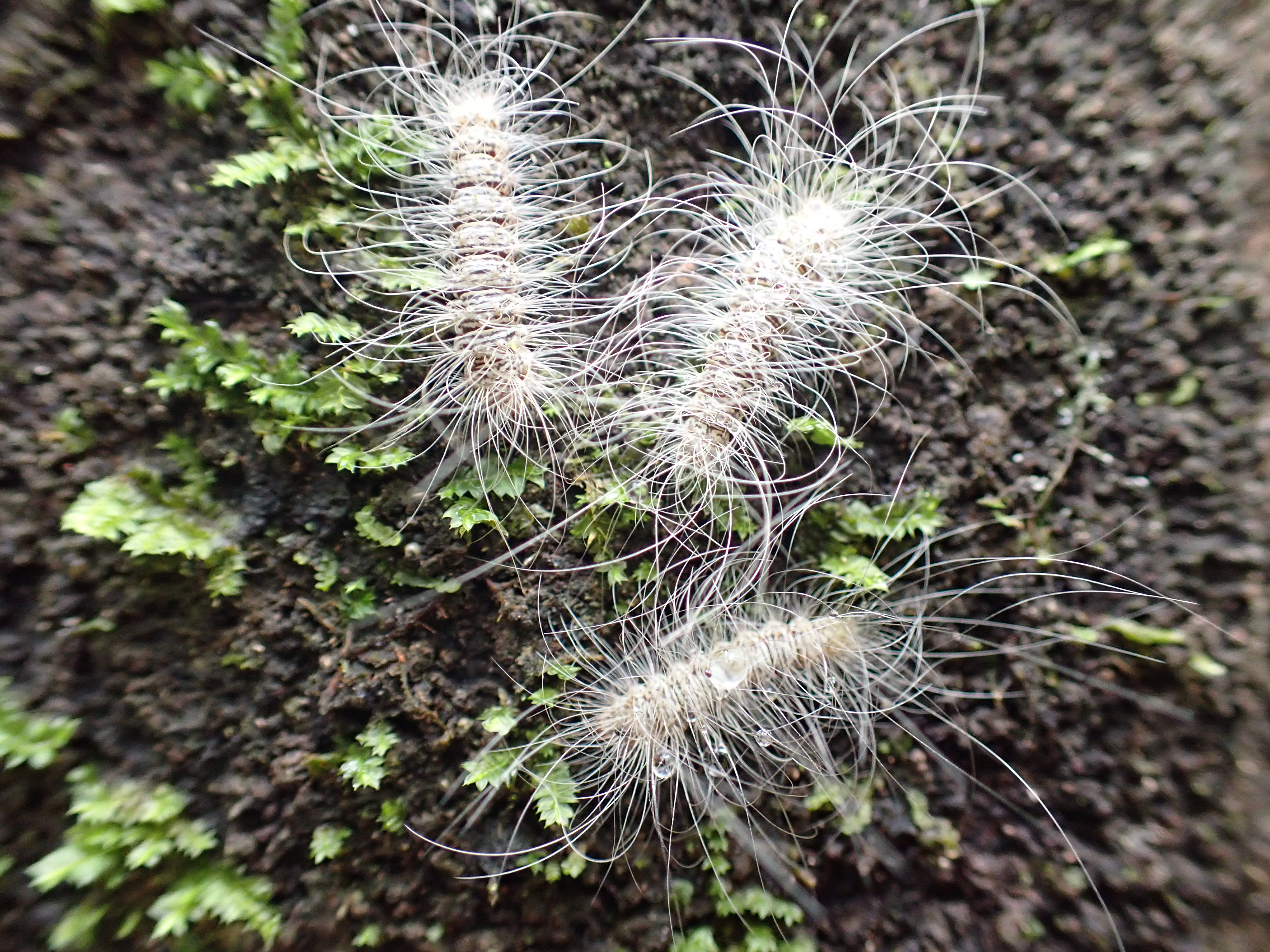
It rained again quite heavily overnight and all the smells of the forest seem amplified today. I got up early to walk the Maya trail and collect some leaves for my first plant ID session. We started in the classroom with a stack of different shaped leaves to recap the students’ basic knowledge of the terms used to describe different shapes of leaves – simple or compound, pinnate or palmate, then we all walked the trail together. After the rain there were impressive land snails on some of the trees and some very interesting looking insect larvae.
Identifying tropical trees is very different to the sort of plant ID most of us are used to – there are almost no flowers to rely on and the nearest leaves are often well above our heads. There are also 139 species native to Belize described in The Trees of La Milpa, as compared to less than 50 in the UK. The size of the tree, the colour and texture of the bark and any smell associated with it become much more important. Some trees have very distinctive bark – the flaky red bark of mature Red Gumbolimbo, Bursera simaruba, gives it the nickname of ‘tourist tree’ after sunburnt pale skins! So called Bastard Mahogany, Lysiloma latisiliquum, is named for the fact that its wood, when freshly cut, can be passed off by unscrupulous traders as its more valuable namesake and also has a very distinctive bark, with thick, regular-shaped, flaky scales. Prickly yellows, Zanthoxylum, of which there are a number of species locally, have bark covered in large, flat-topped prickles which make them look like a dinosaur’s hide.


Smell can be important too. Prickly yellows are in the citrus family and have leaf margins fringed in glands which secrete lemon-scented oil, but often the leaves are too high up to use this as a distinguishing feature. Other leaves are easier to reach and it’s generally easy to recognise members of the pepper family (Piperaceae) which are understory shrubs, by a combination of their droopy looking leaves and the lovely spicy smell these have when crushed in your fingers. Mr Mesh had me chewing the leaves but I won’t be risking that with the students!

Breadnut, (Brosimum alicastrum) whose dried seeds can be ground to produce flour, also has distinctive leaves with a tough underside and a prominent vein around the edges of the leaf connecting all the lateral ones. Once you’ve learned to identify the seedlings, you soon work out where the parent tree is – the seedlings often form a thick mat beneath the parent as the fruits, and the seeds they contain, are too heavy to travel in the wind. Presumably the fruits are eaten in situ and the seeds left behind, which seems an interesting reproductive strategy. It must be just a numbers game – if there are enough of one species of sapling, one is bound to susrive. Much the same is true of the distinctive fruits and seeds of Cedrela, which litter the ground below their parent looking like some sort of dried flower.

The students did well at sustaining their interest as we walked round the trail but were very tired by 11ish so we came back to give them time to write up their notes before lunch, whilst I went to check out suitable sampling sights for our afternoon activity on the Saffron trail. Walking by myself I was lucky enough to see a Swallow-tail butterfly flitting around the edge of the clearing and well-camouflaged Katydids in the leaf litter.


In the afternoon, the students learned to use a Point-centre-quarter method to estimate the density of wood per hectare in the areas of forest around the Saffron trail. This was the first chance for most of the students to go off trail and let’s just say that some enjoyed that more than others!
Dinner was tasty tamales, cooked wrapped in plantain leaves, followed by birthday cakes in honour of the two students with birthdays today – they really appreciated the gesture. Afterwards, four of us went on a night hike with Steve, just along the road out of Las Cuevas. We heard lots of frogs and saw two tree frogs (one a Red-eyed tree frog), a Cut-eyed snake, a stick insect and a Mottled owl, along with a huge Tarantula, which kindly posed for photos. The leaf cutter ants at the entrance to Las Cuevas were very busy again. It intrigues me that, during the day, you sometimes find trails with leaf pieces abandoned all along them. You’d think the ants would finish off what they were doing but there is obviously some sort of ‘stop now, do not pass go’ signal in action.
 heatherkellyblog - travel with me and wonder at what you see!