I’ve had the chance to do some exploring around Chengdu by myself on this trip to China, when Casper has been at Kindergarten and Ed and Kate busy with Isla. Having got my phone set up properly so I can use Google Maps is liberating, and I’ve ventured further afield on the bus for some Christmas shopping, as well as further south and west along the Shahe river than I’ve been before, to its confluence with the Jing Jang river, and north along this to Donghu Park.
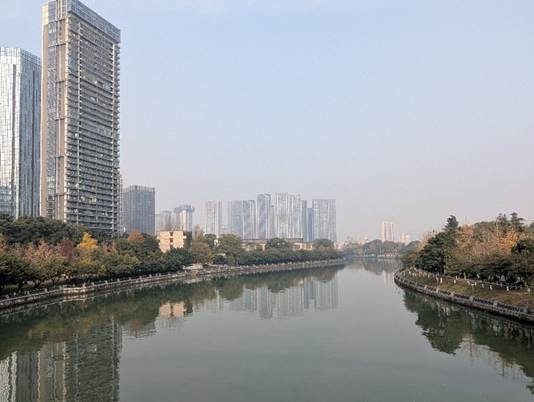
Unfortunately, walking is really the only option for spending time outdoors this time, as air pollution levels in Chengdu in winter make any sort of strenuous outdoor exercise a bad idea – running is restricted to the gym, which is much less appealing than the riverbank. We’ve been at AQI (Air Quality Index) levels of around 120, or ‘unhealthy for sensitive groups’ most of this week but now it’s over 150, ‘unhealthy’ for everyone, and is likely to remain that way for most of the rest of the week. The advice at this level is to avoid outdoor exercise and wear a mask when outdoors and to close your windows and run an air purifier indoors – pretty grim, especially as these levels persist for around four months of the year. At the end of last week the AQI was over 200, or ‘very unhealthy’. The long-term health implications of this level of pollution on the population are scary and are recognized, up to a point, by a local government alert system. Three days with an AQI over 200 is the threshold for a red alert to be issued, although this threshold is, arguably, set much too high (Zhang et al., 2024). Zheng and colleagues, based in Sichuan, argue that a threshold AQI of 130 should be used, as this is the level of pollution at which hospital admissions for respiratory illnesses, heart problems and strokes spike sharply.
Chengdu is one of the cities in China with the worst air pollution; partly as a result of its geography, sitting in a basin surrounded by a ring of mountains which shelters it from the wind, but also because of its rapid expansion, which means there is lots of construction work going on. Although China is transitioning towards the use of green energy very rapidly, there is still a large industrial zone of fossil-fuel powered factories around most cities. To make matters worse, much of the pollution is from the tiniest particles (less than 2.5 µm in diameter, known as PM2.5); small enough to be absorbed into the bloodstream when breathed in. A 2019 report ascribed much of the pollution here to road traffic but now at least 50 % of the private cars on the road are electric, as are all the taxis, buses and scooters, so nitrogen and sulphur dioxides, at least, are less of a problem than they were.
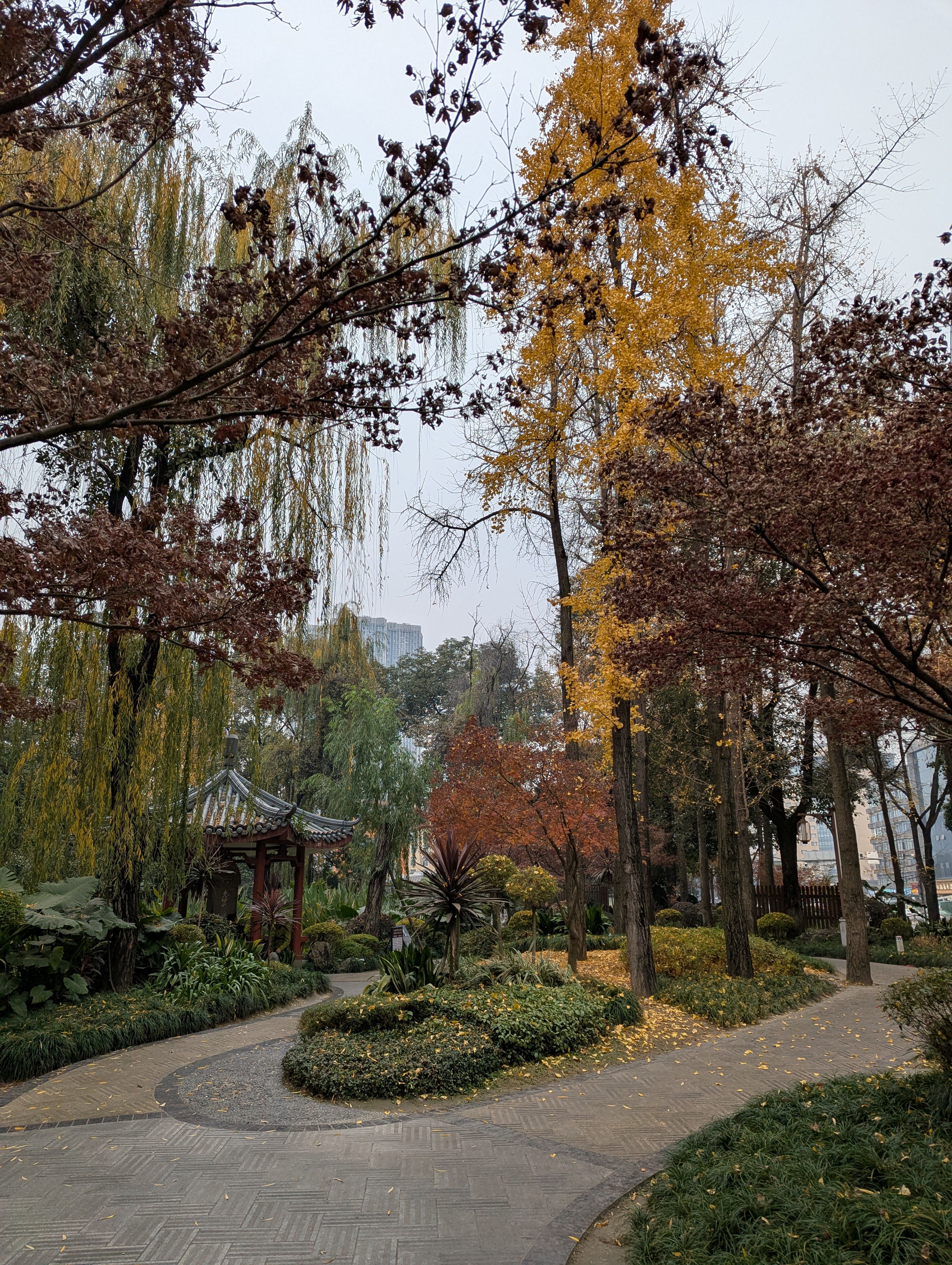
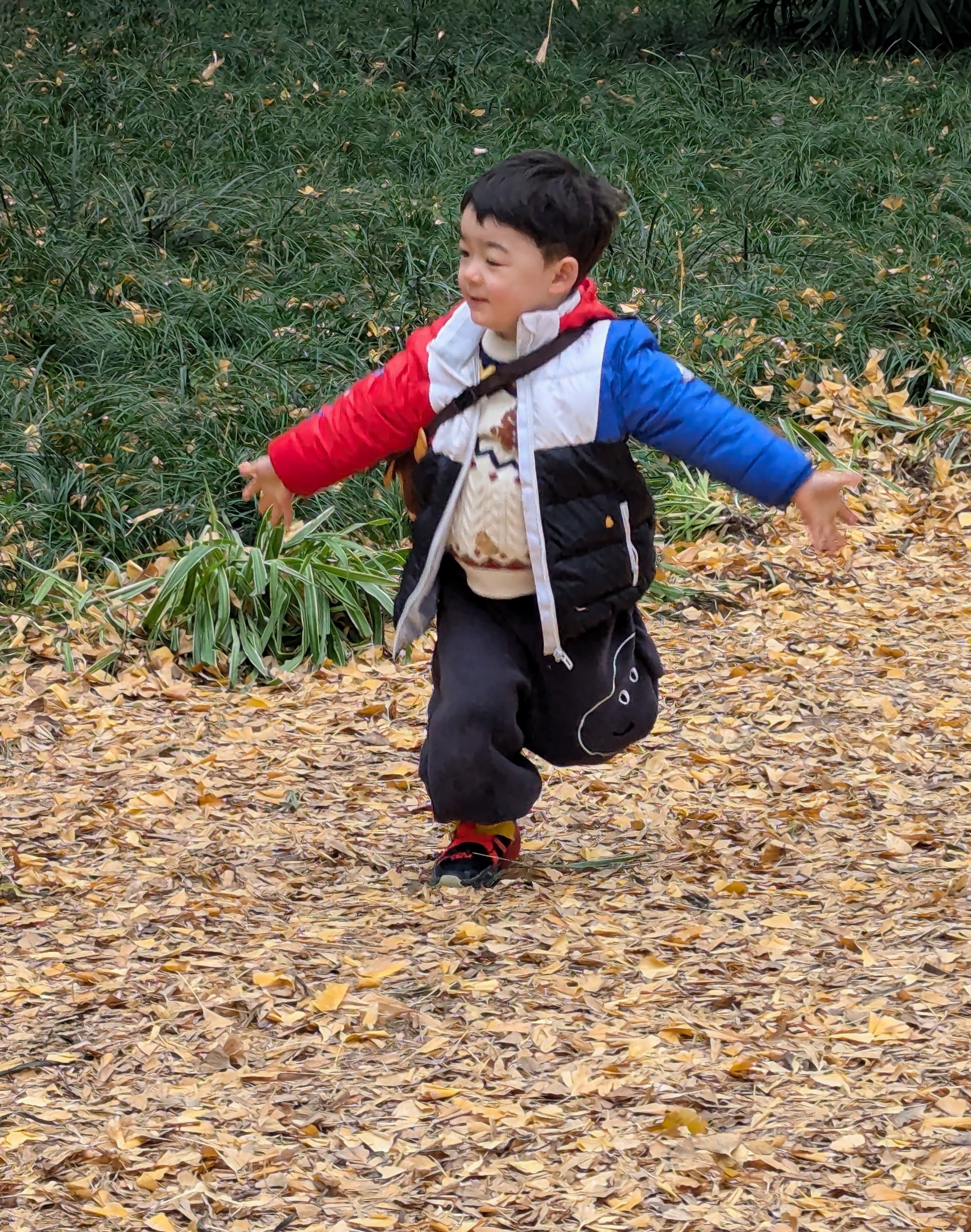
The atmospheric conditions mean that most days at this time of year are unremittingly grey so the rare days when the sky is blue are particularly welcome and I’ve been enjoying the colour of the last Ginkgo leaves of the season. There are noticeably fewer leaves on the trees now than when I arrived a fortnight ago but that has meant piles of golden leaves for Casper and other children to enjoy in the park. Some things are universal!
Over the last couple of weeks I’ve been reading much more than usual! One of the delights of days working to a toddler’s schedule, without the list of jobs I normally have waiting at home, has been the chance to indulge in a lot more reading for pleasure than normal. I was particularly moved by Maggie O’Farrell’s The Vanishing Act of Esme Lennox, about a woman incarcerated for most of her life in a mental hospital, simply for being raped. A Very Bad Thing, by J.T Ellison is a clever, twisted thriller about an author whose life is not at all what her legions of loyal fans believe and You are Here, by David Nicholls, is his classic oddball love story set against a backdrop Wainwright’s Coast to Coast walk, much of the way through landscapes I know and love. What’s not to like!
Zhang J. et al. (2024). When to issue the alert of air pollution in Chinese cities? Evidence on the threshold effect of heavy air pollution from Chengdu. Environmental Impact Assessment Review, 105, 107371
 heatherkellyblog - travel with me and wonder at what you see!
Hi Heather That air quality sounds worrying for bringing up children 😦 but great you have done some exploring!
Linda M H Fowler
On Sun, 28 Dec 2025, 14:27 heatherkellyblog – travel with me and wonder
It’s really not great for anyone, Linda. I hate feeling it’s not safe to be outdoors!
I think I need a “don’t like” emoji 😦 Even today in the French Alps there was a pollution warning in the Arve valley, speed limits reduced by 20 kph, and obligatory “pollution stickers ” to show your vehicle complies.
Linda M H Fowler
On Thu, 1 Jan 2026, 14:52 heatherkellyblog – travel with me and wonder
[…] three week old Isla, taking her to the local mall for a Hong Kong style lunch yesterday. Sadly, the air pollution levels mean long walks with her in her pram, which I’d imagined being part of my role this month, have […]