The last couple of weeks has seen the passing of both the shortest day and longest night of the year (which for a long time I’d assumed were on the same day) and I can’t say I’m sorry to be into the imperceptibly-lengthening days as we head towards spring. Getting out early to exercise is so much harder when it’s dark and it’s no fun cycling both to and from work in the dark; I don’t think it’s a coincidence that I’ve had a difficult-to-shift cold this last week.
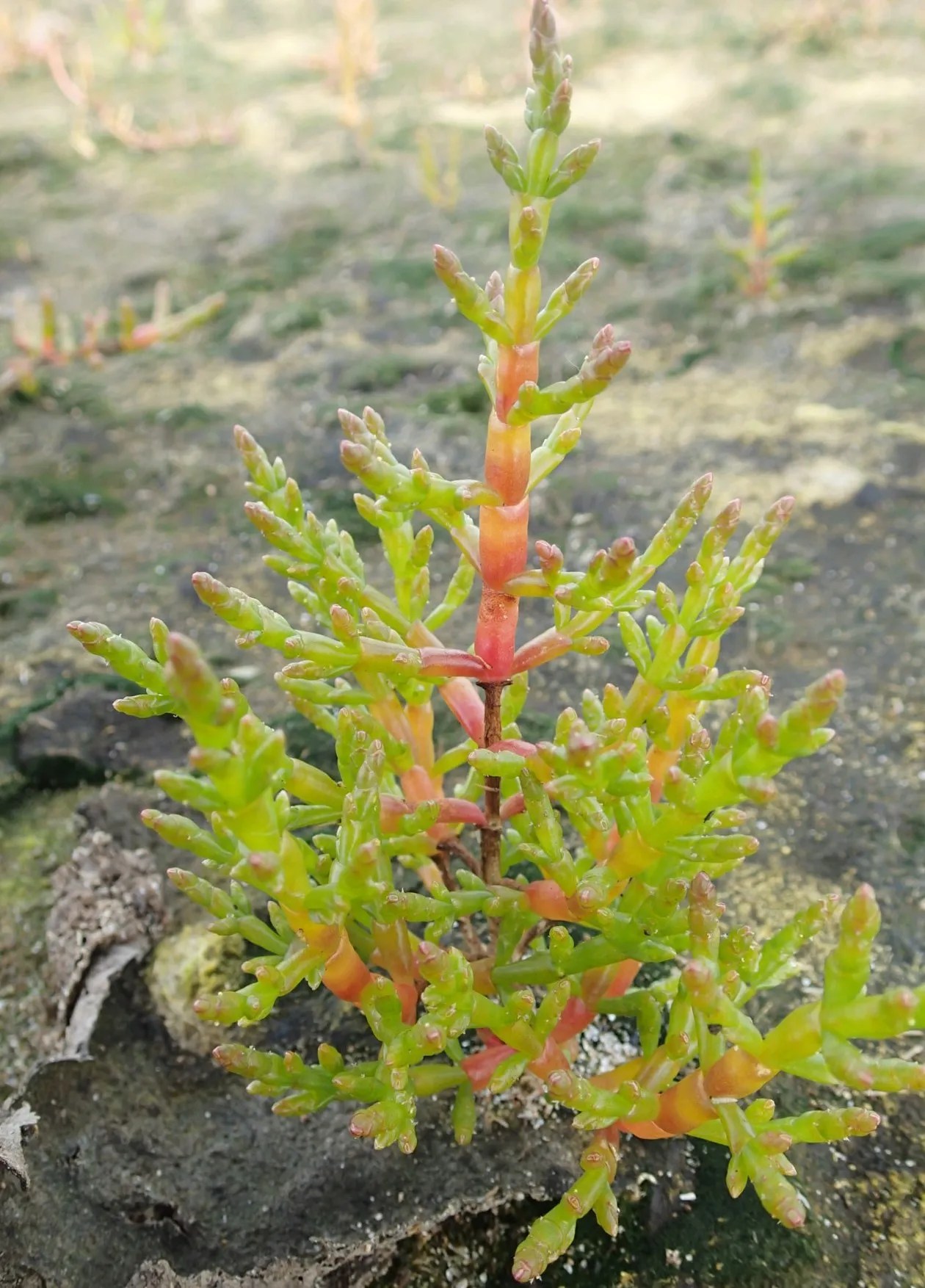
When I have been motivated and well enough to run, I’ve been enjoying hearing and seeing lots of small birds in the trees, though I’ve seen no sign of Fieldfares or Redwings yet. There has also been time for a walk or two along the riverbanks into Durham as well as some rowing, once term finished, to make the most what winter sunshine there has been. Before term finished I was teaching about plants which cope well with nutrient deficiency and other stresses, which at least means I get to show the students insectivorous plants from the Botanic gardens and force-feed them samphire! It’s easy to get students to understand how some plants take up and accumulate salt in their stems and leaves to help them deal with growing in saline conditions when the students can taste how salty these are. The high sodium content of the tissue is one explanation given for the other common name for these plants – glasswort; they were burned to produce soda ash for glass making until the early 19th Century.
I’ve recently joined the social media platform Bluesky, having come off Twitter in disgust some time ago, and have been pleased to see lots of interesting papers for my Christmas reading list. One which caught my eye was an interesting and worrying paper by Lang et al. in Nature Ecology and Evolution. They have shown that the timing of biological cycles in both plants and animals is being affected by climate change but not always to the same extent, meaning there is a risk of important interactions between consumers and producers, prey and predators and plants and their pollinators being jeopardised. Lang et al. analysed 10 million observations made between 1981 and 2020 and saw more and more asynchronicity between plant and animal growth cycles, particularly towards the end of the plant growing season. Later stages of the plant cycle are brought forward, year by year, as the climate warms and buds break earlier in spring, because leaves have a finite lifespan. Animals are arguably less directly affected as they also affected by changes in resource availability, though these may, in turn, depend on climatic effects.
In the garden, the Hellebores are in bloom already, alongside the Mexican Box and some confused-looking Lesser Celandines, as if to reinforce the message of my week’s reading. Celandine flowers are an important source of nectar for queen bumblebees and other insects as they emerge from hibernation and, in turn, depend on these insects for their pollination; there are very few insects around just now. Lang et al. found that these sort of phenological shifts between plants and their pollinators are likely to pollinator visitation to early flowering species, with negative implications for both insects and for plant reproduction.
When gathering greenery to help decorate church for Christmas, I realised I was trampling on snowdrops with a little white already showing and that the daffodil bulbs are also in leaf – a lovely reminder that spring is only just around the corner on the gloomiest winter day!

I’ve been reading ‘Cherry’ Ingram, the Englishman who saved Japan’s blossoms by Japanese journalist Naoko Abe. This biography of Collingwood Ingram, a wealthy man in search of a cause, tells the story of his obsession with all things Japanese, particularly cherry blossom trees or sakura. Ingram became instrumental in helping to preserve the diversity of Japanese cherry blossom trees, partly by growing and breeding a wide variety of trees here in the UK, when diversity was endangered by mass planting of a single variety, Somei-yoshino, in early 20th Century Japan – long before worrying about biodiversity was fashionable! Perhaps the most fascinating thing in the book is the role cherry blossom plays in Japanese culture, and how this was manipulated by those in power in the run up to the second world war. The ephemeral beauty of the blossom was used persuade young men to sacrifice themselves for the good of Japan, as soldiers or as kamikaze pilots.
The culinary highlight of the week before Christmas was undoubtedly a delicious belated birthday lunch at Coarse, in Durham, with Heather and Camilla. Everything was delicious, with the tempura Korean cauliflower a particular highlight for me. Equally impressive was the way the staff effortlessly serving two vegetarian meals alongside one with minimal substitutions to make it vegan.
Lang, W., Zhang, Y., Li, X. et al. (2024) Phenological divergence between plants and animals under climate change. Nat. Ecol. Evol. https://doi.org/10.1038/s41559-024-02597-0
 heatherkellyblog - travel with me and wonder at what you see!
Good reading as ever! Where do we find you on Bluesky? I moved the OUGS presence across there from X a little while ago and it is a much more pleasant place to be https://bsky.app/profile/ougeolsoc.bsky.social Happy new year! Linda
On Mon, 30 Dec 2024, 09:17 heatherkellyblog – travel with me and wonder
And happy new year to you too, Linda. Thanks for the Bluesky link for the OUGS. The link to mine should be in the blog but, if not, I’m @ohnstadio.bsky.social 🙂
Not good to hear of the change of correlation between plants and insects but I guess that adaptions will always be happening. Wonder how long it would take for a celandine to realise that there were no insects around for pollination?
It is worrying! Fortunately it’s only the odd celandine in flower at the moment – hopefully most will wait until the weather is warmer!
Sorry I seem to have managed to lose your later kind comment. I think this is the cauliflower wellington recipe I used – it was very tasty 🙂
https://www.deliciousmagazine.co.uk/recipes/cauliflower-wellington/