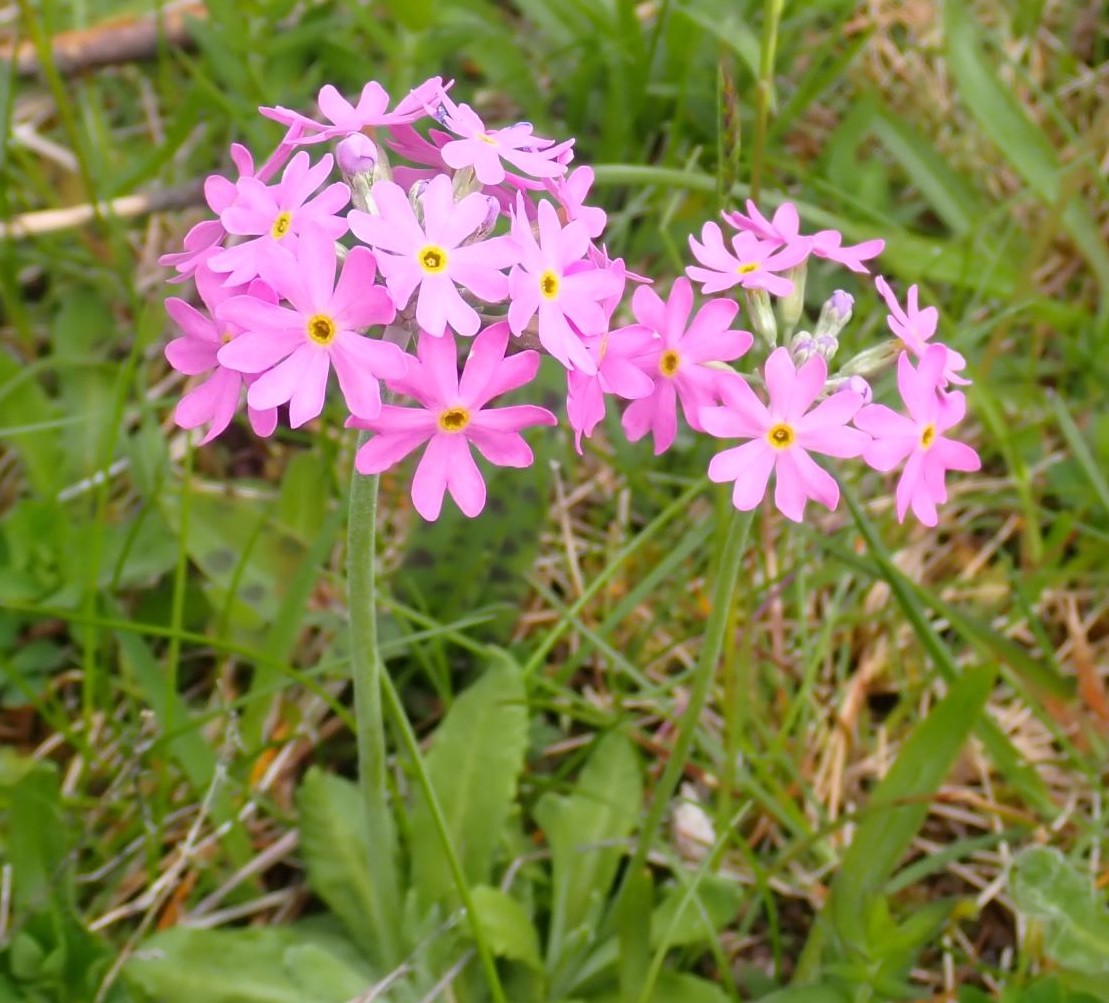
In my head, endemic species come from more exotic parts of the world than our home islands; places like Cyprus, with its unique geology, or Madagascar, so long isolated from mainland Africa. So it was a surprise to learn in James Harding-Morris’s fascinating book that at least 700 species and 100 sub-species of plants, animals and fungi, and possibly many, many more, are found nowhere in the world apart from Britain. Most diverged from their counterparts in mainland Europe when Britain became an island, between seven and 11 thousand years ago. The vast majority are plants, often small and found in only one tiny part of our islands and go unnoticed by almost all of us. A case in point is Harding-Morris’s description of hunting for the global population of tiny, white-flowered Yorkshire Sandwort on the Eastern flanks of Ingleborough. Although I’m a keen botanist, when we did the Yorkshire Three Peaks last May it was the show-stopping number of dainty Bird’s-eye Primroses which caught my attention. To be fair, many of our endemic species look very similar to their more common relatives, to the untutored eye. If I had seen Yorkshire Sandwort, I’d probably have assumed it was the Spring Sandwort I see in Upper Teesdale!
The author’s mission was to visit and bring to our attention 20 of these endemic species over a year or so, as ambassadors for our islands’ unique biodiversity; he actually encountered, and writes about, many more fascinating species on his travels. Although he currently works as Countries Manager for the BSBI, supporting a network of Botanists across Britain and Ireland, Harding-Morris has worked in the past on community engagement projects with the RSPB and on the collaborative ‘Back from the Brink’ programme instigated by Natural England and is interested in all manner of living organisms. He is a pan-species lister and one of the appeals of the book is the diversity of the organisms he introduces us to; from the Northern February Red Stonefly, one of our few endemic invertebrates, to Bertha’s Dandelion, one of 29 endemic dandelion species, taking in our only endemic fungus, the British Earthstar, and our oldest endemic species, the British Cave Shrimp, on the way.
However, Harding-Morris is not just a list-ticker but is an enthusiast, clearly fascinated by, and finding beauty in, the species he encounters; be that the exquisite veining of the stonefly’s wings or the miniature rainbows refracted from the tiny scales on a Chater’s Bristletail. I love his description of the crowded spikelets of our only endemic grass, Interrupted Brome, as looking like someone who has crunched their head down into their shoulders to avoid being tickled on the back of their neck. I’ll never look at a Fumitory flower the same way either – he claims they look like the head of the alien in the eponymous film, ‘complete with protruding internal mouth’, if it was made out of delicate petals! His delight at the ‘bonus’ endemics he finds, such as the sub-species of Silver-studded Blue and Grayling butterflies on the Great Orme, is palpable and infectious and his description of the interconnected subterranean world which sits beneath our feet, unnoticed, in chalk and limestone landscapes helps us understand how the British Cave Shrimp has been endemic here for millions of years; since well before Britain became an island.
He is also a natural storyteller. Many of the species in the book are found in remote and inaccessible places and hunting for them, in the company of the expert natural historians who are generally his guides, can be quite an adventure. Exploring Buckfastleigh’s Pengelly Caves in the search for tiny Cave Shrimps is certainly not for the fainthearted. I found his description of hunting for the remaining few Baker’s Hawkweed plants along a part of the River Tees I know very well particularly evocative, but the range of places he visited means that most naturalists will recognise somewhere they know and love. The book makes very clear how much our knowledge of often-inconspicuous endemic species depends on passionate amateurs, who work alongside conservation organisations seeking to create conditions in which they can thrive. As a botanist I feel the work of Andy Shaw, who runs the Rare British Plants Nursery in Wales, growing and conserving a wide range of our rarest and most threatened plants for research, restoration and reintroduction, deserves a special mention.
Sometimes it’s unclear whether a species is endemic or not or even, indeed, whether it is a separate species; Harding-Morris explores this in some detail. It seems to be particularly troublesome for our small number of potentially-endemic bird species, such as the Scottish Crossbill, which can only be told apart from its more common cousin by its call, or the habitat it prefers. Maybe it’s not surprising that birds are the least common endemics, given their mobility and our proximity to continental Europe. And then there are what Harding-Morris calls ‘false endemics’, such as the three species of millipede only currently found in South Wales but strongly suspected to have come originally from the Iberian Peninsula, in association with the mining industry which linked the regions in the past.
The book also considers the origins of our truly endemic species and explains the puzzle of why so many of these are closely related. Who knew that there are at least 58 endemic species of Goldilocks Buttercups, and perhaps hundreds more, named for the regions where they were first identified? These species reproduce clonally so offspring are, in theory, identical to their parents. This means that any small genetic changes can become fixed over time in particular populations until they are distinctive enough to be considered a new species. In other cases, endemics arise from hybridisation, where two related species reproduce and manage to produce fertile offspring. The tale of York Ragwort, a hybrid between Oxford Ragwort and Groundsel, is a fascinating and inspiring one, the first I’ve heard of where Kew’s Millenium Seed Bank has been used to resurrect an ‘extinct’ species. Found only in and around York in the 1980s, indiscriminate use of weedkillers in the city eradicated York Ragwort only 20 or so years after it was first recognised as a species. Fortunately, seeds had been taken to Wakehurst Place and Andrew Shaw has managed to grow up enough plants from these, in his nursery, to produce and collect over 100 000 new seeds, which are now being reintroduced to scraps of waste ground in and around York.
Many of the endemics in the book are under threat from climate change, groundwater extraction, urbanisation, pollution and the use of weedkillers but Harding-Morris points out that this not always recognised. Organisms may be flourishing in some parts of the country (often further north), so don’t qualify for legal protection, despite disappearing from other parts of their range. Even when species are protected, climate change can pose a threat which is not easily mitigated. A case in point is the critically endangered endemic, Menai Strait Whitebeam. Forty or so individuals, found only on the Welsh coast opposite Anglesey, are losing their battle against coastal erosion caused by rising sea levels. Unless helped to relocate to other sites along the coast, they may become Britain’s first endemic casualty of climate change.
Harding-Morris is a passionate advocate of the role of community scientists working with charities such as Buglife, the RSPB and the BSBI in helping us understand the conditions some of these special species need to thrive, in order to plan conservation efforts. And also of the need to ditch our obsession with tidiness so that plants, and the insects, animals and birds they support, can thrive again on road verges and ‘waste’ ground. His book is a timely wakeup call for us to pay attention to the vulnerable species on our own doorstep, rather than thinking of biodiversity loss as something happening in far-flung corners of the world. Harding-Morris points out that we can’t look after what we don’t know is rare – how does someone spraying dandelions to ‘tidy up’ a grass verge know whether they are killing a rare, endemic species or one of our most common ones? On the other hand, judicious mowing or grazing is often key to letting smaller or less competitive species such as the British Earthstar flourish; yet again, it’s back to learning as much as we can about what these species need to thrive so we can manage their habitats sensitively and look after the biodiversity in our particular corner of the planet.
HARDING-MORRIS, J. Endemic: Exploring the Wildlife Unique to Britain. 336 pages, 20 b&w images open each chapter, London: Bloomsbury Wildlife, 2025, hardback, £20.00, also available as Ebook, ISBN:978-1-3994-0567-6, Endemic: Exploring the wildlife unique to Britain: James Harding-Morris: Bloomsbury Wildlife – Bloomsbury
 heatherkellyblog - travel with me and wonder at what you see!
I hope Lundy Cabbage gets a mention? 😉
Linda M H Fowler
On Wed, 17 Dec 2025, 10:39 heatherkellyblog – travel with me and wonder
It does indeed, Linda, and there are other things of interest on Lundy too – it made me want to go and visit 🙂