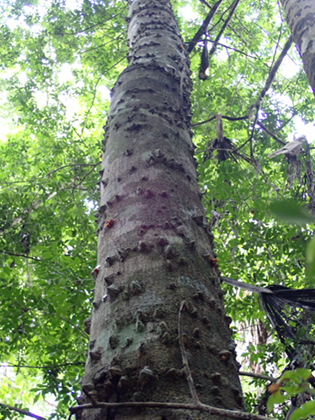
Recently, reading a part of the novel Saving Fish from Drowning by Amy Tan set in Lijiang in China, I came a description of the mouth-numbing properties of Zanthoxylum, commonly known as Sichuan pepper. I’ve had plenty of firsthand experience of this, with family in Chengdu. Imagine my surprise, though, when I realised I’d seen trees of the same genus in Belize, last September. Members of the Rutaceae or Citrus family, the genus Zanthoxylum (literally ‘yellow wood’) goes by the common name of ‘Prickly Yellow’ in Belize, on account the spiny bark which covers its yellow heartwood. In other places Zanthoxylums are known as ‘Prickly Ash’. There are actually seven species of Zanthoxylum in Belize, and around 250 globally, so my ID for the species we saw is tentative, to say the least, particularly given the difficulties of seeing anything other than the bark up close.
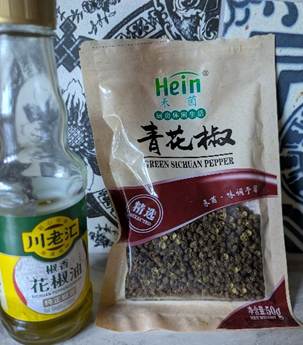
Unlike the members of the Citrus family we are more familiar with, it’s the outer husks of the fruits which are of interest in these trees. Several different species are described as red, green or wild ‘Sichuan pepper’, including Zanthoxylum bungeanum, Z. simulans and Z. armatum. The dried outer shells of the fruits are ground up as a component of Chinese five-spice powder or used neat in many foods in this part of China, including the ubiquitous Mapo tofu and the fish soups which are the highlight of many Sichuan meals. The dried fruits don’t keep their heat very long so are also used to flavour oils used in cooking.
The numbness is brought about by a chemical known as hydroxy-alpha sanshool, which acts in a similar way to local anaesthetics by over-activating somatosensory neurons in the tongue, which normally detect stimuli such as gentle touch. Maybe I shouldn’t have been surprised that Sichuan peppers are in the Citrus family, as they have a lemony flavour profile in addition to their mouth-numbing properties.
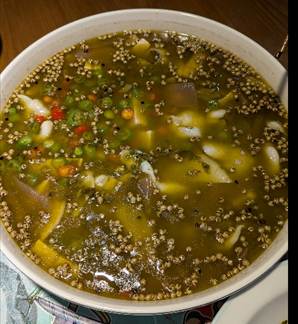
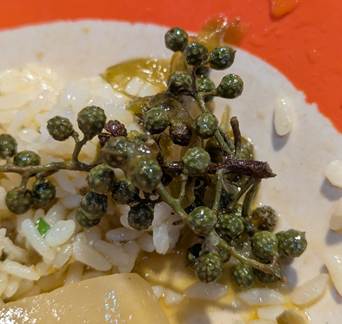
On our current trip to Chengdu we ate delicious fish soup swimming with fresh green Sichuan peppers, as well as the regular dried ones (and plenty of chilli) on a visit to a new Sichuan restaurant near Ed and Kate’s. It has always struck me as surprising that heat from chilli peppers should play such a key role in Sichuan food, given that they are native to the Americas and didn’t arrive in this part of the world until brought by Portuguese traders in the 16th Century. At first, chilli plants were largely grown as ornamentals for their decorative flowers and fruits before gradually, over the course of a century, the fruits were first incorporated into TCM (Traditional Chinese Medicine) as ‘warming’ remedies against conditions associated with cold and dampness, then finally incorporated as culinary ingredients.
Instead of activating neurones in the tongue which respond to touch, capsaicin (the heat-producing agent in chillis) activates the neurones in the tongue which detect pain. The theory goes that, when Sichuan peppers and chillis are used together in a dish, the numbing effect of the pepper reduces the heating effect of the chilli, so its fruity flavours can be better appreciated. I feel that is a bit of a moot point to most western palates!
Whilst we’ve been away I’ve been reading The Sentence, by Louise Erdrich, a powerful semi-autobiographical novel about how an indigenous American woman is haunted by her past. The novel is set in Minneapolis against the backdrop of Covid and the protests which followed the death of George Floyd.
We’ve been eating a wide range of Sichuan food this week – tempered by the occasional foray into home-cooked European food and a notable brunch with Kate’s family at Fields Concord restaurant in the Taikoo Li mall, near where we stayed on our first trip to Chengdu in 2019. The restaurant describes itself as modern Spanish, which might be a bit of a stretch, but the unlimited buffet type starters and tapas-style mains were very tasty, particularly my grilled fillet of mackerel with tempura kale.
Cultural highlight options are a little limited with a four-month-old and a nearly four year old in tow, but the day trip with Casper’s kindergarten to Dujiang Yanchuanxi Tea Valley was an eye-opener and lots of fun – more on that to come.

