The environmental historian and author of Ghosts Behind Glass, Professor Dolly Jørgensen, is a woman on a mission; between 2014 and 2024 she visited more than 70 museums all over the world, from giants such as London’s Natural History Museum (NHM) and the Smithsonian in Washington to smaller museums in other parts of the UK and Europe, Africa and Australasia, to experience the different ways in which museums can help us encounter species we have lost – the ghosts of the book’s title. This seems particularly pertinent in the midst of the Anthropocene defaunation, probably the most rapid mass extinction event in our planet’s history. 776 animal species are known to have become extinct in the last 500 years according to the IUCN, whilst others have seen a huge decline in numbers. That’s without considering the myriad smaller creatures and plants which have disappeared with much less fanfare and, often, without us even being aware of them. Even when we have specimens, smaller species such as reptiles and insects are largely confined to the back rooms of museums and used for research; most of the ‘ghosts’ on display in museums are of larger, more charismatic organisms.
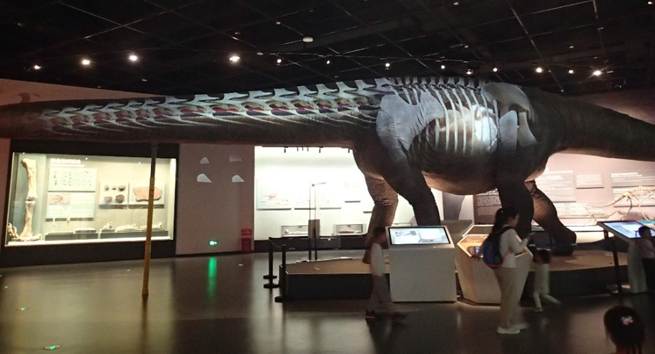
Some animals, of course, became extinct long before humans appeared. Say ‘Natural History Museum’ to most British people of a certain age and they will visualise the reconstructed skeleton of Dippy the Diplodocus dominating the central hall. But Jørgensen points out, for more recently extinct species, there is other evidence at our disposal; animals can be presented by taxidermy, as models or as drawn or painted images. They can be displayed in a diorama to show their role in an ecosystem or re-animated using Augmented Reality. Each creates a different response in the viewer; a skeleton couldn’t look more dead, whilst a carefully posed stuffed animal can seem very alive. Clever use of projection, superimposing images of the skeleton and circulatory system on a life-size model of Mamenchisaurus in Chengdu’s natural history museum, which I recently visited with Casper, really brings the surrounding dinosaur skeletons to life.
The way in which remains are curated and displayed affects our reaction to them. Some museums group all their extinct creatures together, perhaps along with a display about currently endangered species, giving an opportunity for a strong message about threats to wildlife. Jørgensen points out that, sometimes, there is uncertainty about whether or not a species is actually extinct. Both the Tasmanian Tiger (or Thylacine) and the Ivory-billed Woodpecker are amongst those presumed extinct but proving absence categorically is no mean feat. Other museums place organisms in taxonomic or geographical groupings, to provide more context about which groups or ecosystems are most affected by human activity. When an individual animal’s life-story is known, as is the case with Martha, the last Passenger Pigeon, this can be used to forge a very direct connection with the viewer.
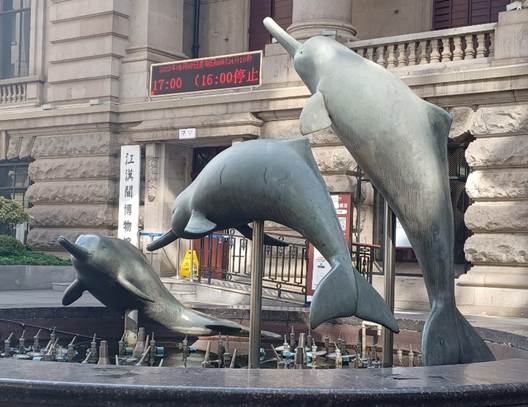
Jørgensen has three main arguments for why we should display tangible evidence of lost species. One is that we must tell the truth about the effects of our actions, though understanding that people see history through different lenses; whilst the extirpation of the Yangtze River dolphin in the early 21st Century is seen by conservationists as a tragic impact of the Three Gorges hydroelectric project, others see it as an inevitable consequence of China’s drive for greener energy.
Jørgensen’s second argument is that we need a solemn space in which to remember loss; it’s no co-incidence that the list of extinct species in the National Museum of Scotland, ‘In Memoriam 1600-2020’, looks like a war memorial or that the London NHM’s ‘Treasures’ exhibition, is presented in a church-like gallery with stained glass windows. Her final, and most important, argument is that we need to instil a ‘never again’ ethic, particularly about the casual way in which species like the American Passenger Pigeon were slaughtered in vast numbers because they were believed too numerous to disappear.
Many natural history museums have their origins in the ‘Cabinets of Curiosities’ of wealthy individuals; London’s grew from the original British Museum collection of 18th Century globetrotter Sir Hans Sloane. When the natural history element outgrew its home in the late 19th Century, a brand-new museum was built. The visionary curator, Sir Richard Owen, created a ‘cathedral to nature’, large enough to house new material brought from all over the empire by Victorian explorers, and made it freely available to the general public for the first time. His goal, as today, was to inform and educate as well as to preserve artefacts for posterity.
The burning question for Casper, in Chengdu, was why the people in the museum had killed the animals displayed (not the dinosaurs of course – he knows all about their demise!) A surprisingly apposite question, it turns out, as most specimens in many museums were deliberately killed by hunters or collectors. Early museums even funded expeditions to collect the last individuals of species believed destined for extinction, to preserve evidence of them. William Hornaday’s 1886 expedition to collect examples of the last American Bison, supported by the Smithsonian Institute, is a case in point.
Large museums with global collections obviously have an important educational role but I’d not previously considered the difference between seeing an extinct animal displayed where it once lived and a specimen transported halfway across the world to sit in an extensive collection of curiosities. Chapter four of Jørgensen’s book looks at the Dodo and Japanese River Otter as examples of how extinct endemic animals can still have great cultural significance locally. The Dodo, most iconic of all species made extinct by humans, was lost by the 1660s but still features on bank notes, coins and stamps in Mauritius.
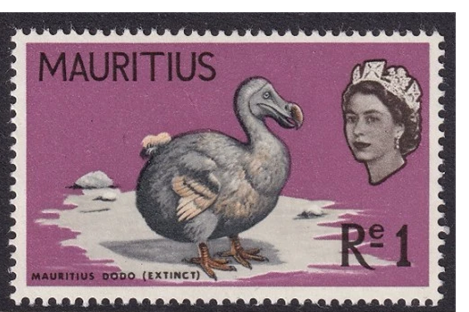
Although ‘Dodo’ is sometimes a by-word for something rather stupid and slow, these birds simply lived on an uninhabited island without predators and stood no chance of evolving quickly enough to survive hunting by Dutch settlers or falling prey to the rats and pigs they introduced.
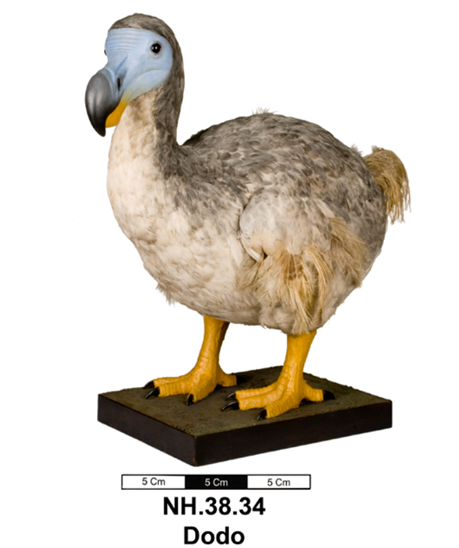
I was amazed to discover from the book that there is only one complete Dodo skeleton in the world, in the natural history museum in Port Louis, Mauritius. Every other one is a composite, made from a haul of 4000-year-old bones found in the Mare aux Songes swamp on the island. Even more surprisingly, no stuffed Dodos exist anywhere – the only fleshy remains are one mummified skull in Oxford’s NHM, with a single small feather. Every other ‘Dodo’ is faux taxidermy, based on a composite skeleton and covered in chicken, turkey or goose feathers. It’s no surprise, then, that much conjecture was involved in their construction; new evidence, from recent skeletal studies and contemporary paintings is altering how we see them. Dodos were probably much slimmer, with longer legs than this model from the Horniman museum would suggest.
In the past, glass cases full of ‘wonders’ might have been enough to engage the public, but we now know more about how to do this effectively, using tools such as Augmented Reality. Sometimes it can be even simpler. I was struck by Jørgensen’s account of her reaction to the audio recording which plays as you enter the Thylacine room in Brussels’ Institute of Natural Sciences; the bleating of a sheep, footsteps, a gunshot and high-pitched howl. More footsteps, whimpering and a second gunshot.
I learnt a lot from Jørgensen’s book about how curation can help shape our attitudes to extinct and endangered species. It’s a fascinating read and made me want to look more carefully next time I visit a natural history museum, though that might need to be without a four-year-old in tow!

