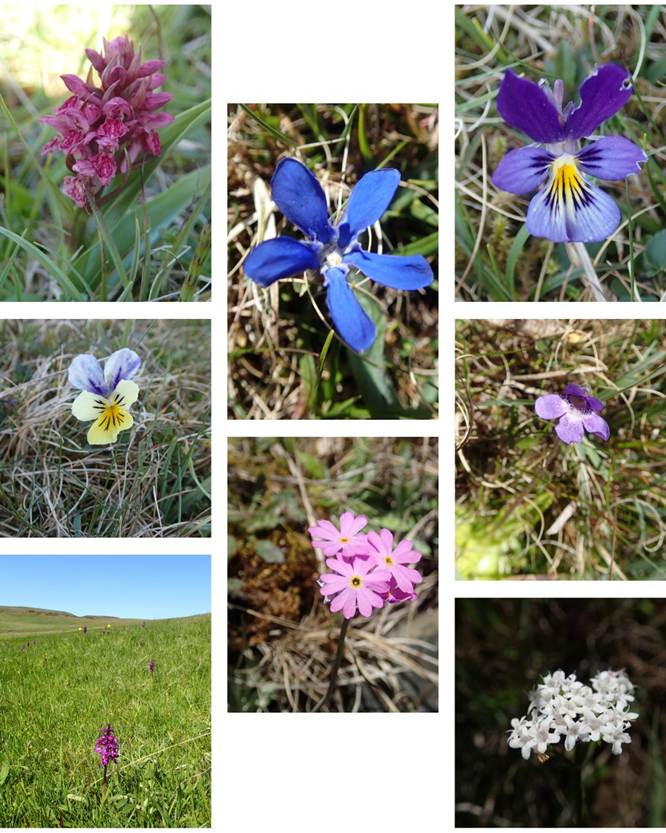
When the rest of the world was sunning itself on a beach last Monday, we thought we’d head in the opposite direction, as far inland as possible to Upper Teesdale, to walk our regular eight mile loop from the car park at Cow Green reservoir. Normally we try and get there earlier in May, to be sure of catching the Spring Gentians in flower, but that just didn’t happen this year, though we were lucky enough to find one hanger on. The advantages of a later trip were clear, just as in June nine years ago. We saw a magnificent array of late spring flowers; many colours of Mountain pansies, Louseworts Violets, Bird’s-eye Primrose, Globeflowers and orchids amongst them.
The biggest botanic surprise was the hay meadow by Widdybank farm which is now full of beautiful Globeflowers, Trollius europaeus. I’m used to seeing small patches a little further down the Tees, near Low Force, but not seeing swathes of the lemon-yellow blooms. Even from a distance you can see they are not the usual buttercups or golden Marsh Marigolds.
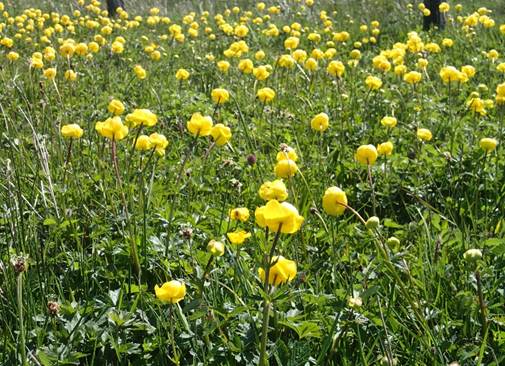
Globeflowers like alkaline soils but are sensitive to over-grazing, so their thriving here is a sign of how sensitively grazing by the sheep and herd of Belted Galloway cows on the reserve is being managed.
Unusually for me, though, the birds were the real stars of the show, providing a soundscape to lift the heart; Lapwing, Redshank, Curlew and Oystercatchers in abundance and a pair of Ring Ouzels flitting across the river. A pair of Curlew sat on the wall by the road, almost close enough to touch – their long, curved beaks give the birds such a top-heavy appearance, it always makes me smile. Amidst such abundance, it’s hard to believe we are in the middle of such a calamitous period of biodiversity loss or that the UK is one of the most nature-depleted countries in the world, according to the 2023 State of Nature report.
Perhaps it’s the book I’m currently reading, Hannah Ritchie’s Not the End of the World which is helping me feel optimistic at the moment. As Deputy Editor and Lead Researcher for Our World in Data, Ritchie is adept at making sense of the vast amounts of data on topics close to my heart, including climate change and biodiversity loss, and is able to point out that many things have already passed their ‘worst’ stage, despite what the headlines would have us believe. She cites examples such as the way the thinning ozone layer was dealt with by the global Montreal Protocol rapidly phasing out CFCs in the late 1980s, or how pollution in many countries, including parts of China, has been reduced by a massive switch to electric vehicles. She is far from complacent about the scale of the problem we face in trying to limit global temperature increases to under two degrees Celsius but is clear that we already have many of the tools to make the changes we need to halt, and slowly reverse, much of the damage we have done, if the political will is there. It’s a refreshing change. I appreciate the fact that she doesn’t preach, but lays out the facts, leaving us to make our own minds up. To Ritchie, the most frustrating thing is when well intentioned people, like me, make changes to their lifestyle (things like buying locally produced food to avoid ‘air miles’ and eating as much organic food as possible to avoid polluting the environment with fertilisers) when these things may, counterintuitively, do more damage than good. Much food for thought, if you’ll excuse the pun.
I’ve also been reading, or rather listening to, Project Hail Mary by Andy Weir, having very much enjoyed the film. It’s a long read, with much more room for nuance about the science of interstellar travel and learning to communicate with an alien being, than the film.
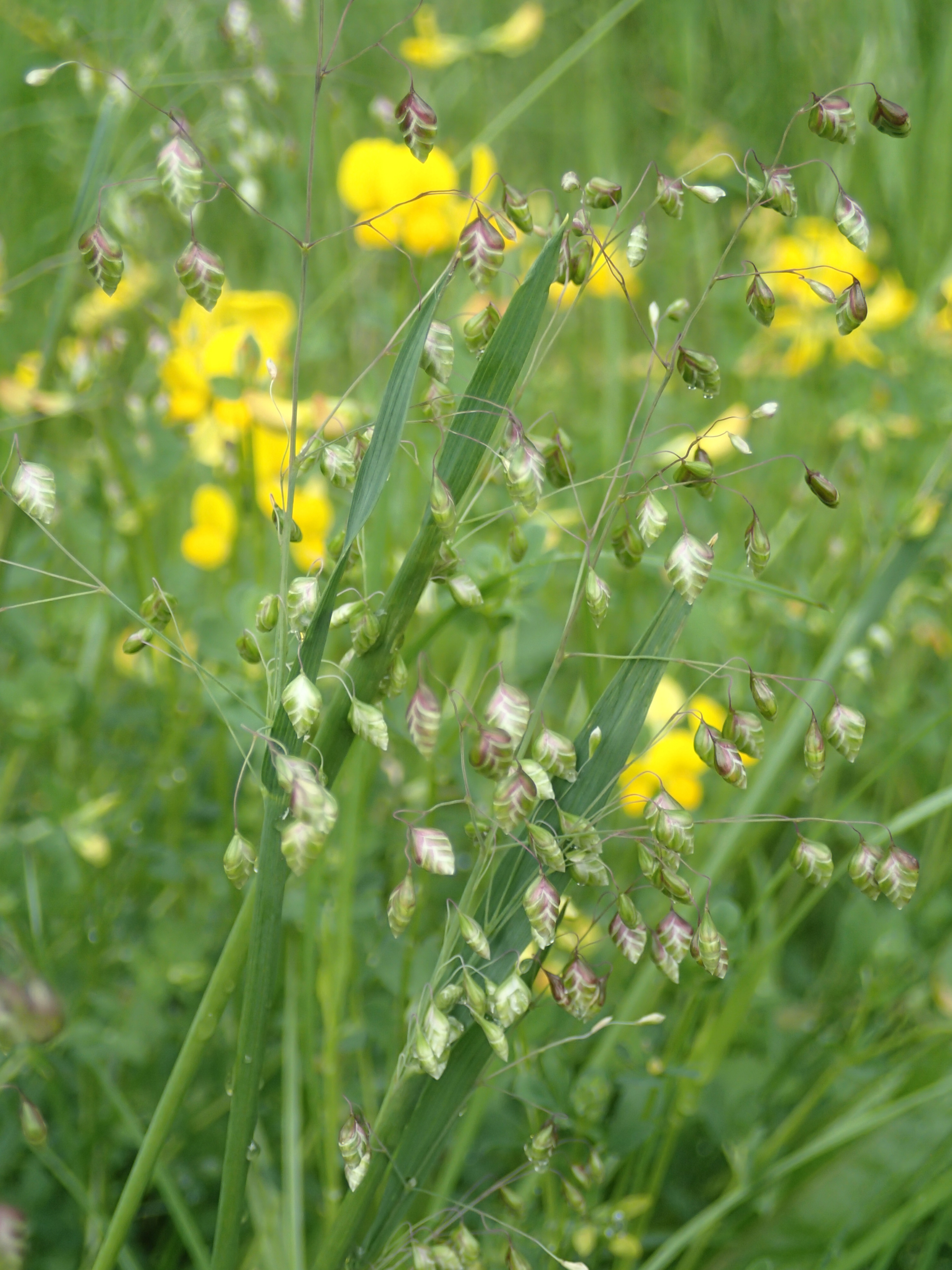
In the garden, no-mow May is at its climax. The back is full of Red Campion, Wood Cranesbill, Crosswort and the first Ox-eye daisies. The front ‘lawn’ is as much yellow as green, with Bird’s foot trefoil thriving in the shallow soil and interspersed with clumps of Quaking grass, much to my delight.
In the allotment I’ve been planting peas and beans, the potatoes seem to have recovered from damage caused by a late frost and we’re eating rhubarb, chard, lovage and very soon lettuce and coriander. The bed I mulched with garden compost last year is a mass of Ox-eye daisies, Campion and Foxgloves – it’s a good thing I have more space than I need for growing food!


Delightful photos
Thank you 🙂