I’ve written before about how lots of the Borage family of plants (Forget-me-nots and the like) have flowers which change colour from red or pink to blue, and how some Primulas have a ring at the top of the corolla-tube which changes colour after pollination, usually from white to yellow. Flower colour is all about attracting insect pollinators, and these changes signal to pollinators which flowers are fresh enough still to be carrying a nectar reward and have a fertile stigma.
The Glacier Crowfoot (Ranunculus glacialis) which we saw growing in abundance at Diavolezza and on Piz Languard last week takes this colour change to such an extreme that the flowers almost look like two different species. The unfertilised flowers are bright white and open wide, to entice any nearby pollinators, whilst the petals of pollinated flowers are retained rather than being shed, as they are in most flowers. The petals turn dark red and fold inwards to enclose and protect the developing achenes (seed-like structures). The colour change here may have a rather different role than in the Forget-me-nots – at this altitude the issue may be protecting the developing achenes from excessive solar radiation, particularly at the high energy UV end of the spectrum, so perhaps carotenoid photo-protective pigments are involved, rather than anthocyanins.
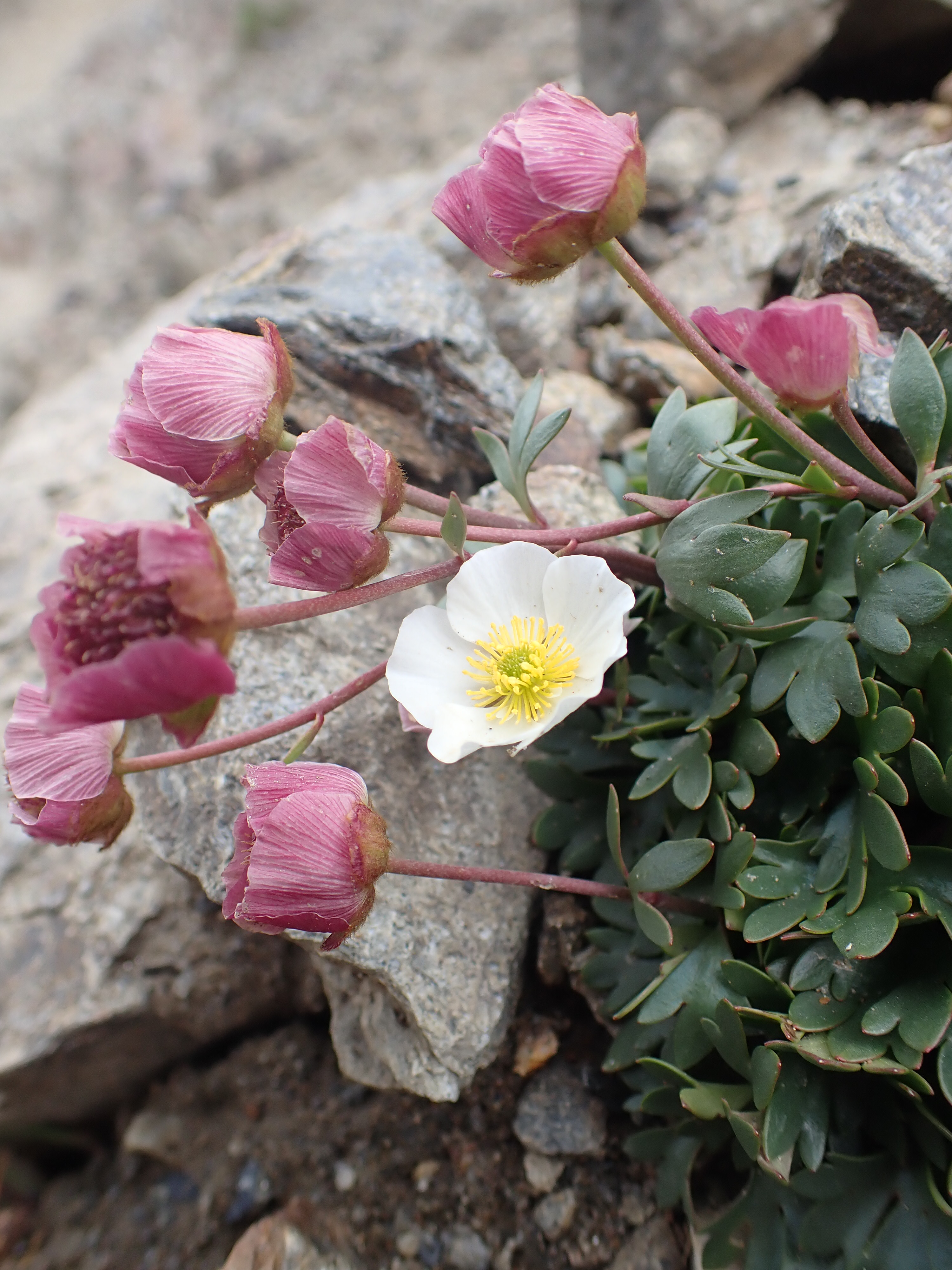
The achenes are released while still immature, green and able to photosynthesise, so that they can mature independently of the parent plant. At this stage, the embryo which will develop into a new plant is relatively undifferentiated, and so cannot germinate. According to Wagner et al. (2010), it seems likely that the embryo remains dormant over the winter, then develops further in the next growing season, so it is ready to germinate the following spring.
Glacier Crowfoot is one of only 12 or so plants which can flower and set seed at altitudes of around 4000 m above sea level in the Alps, so how much are these changes an adaptation to the extreme conditions under which it grows? At high altitudes in the Alps, the growing season is only about ten to twelve weeks long and, within that period, there will be plenty of night frosts. Mean temperatures range from about four to eight degrees Celsius. I was surprised by the number of pollinating insects around at Diavolezza (3000 m) and on the upper parts of Piz Languard (3200 m), including butterflies, hoverflies and the occasional bee, but these insects spend most of their time at lower altitudes, ascending to the highest areas only when the sun is warm.
Typically for buttercups, Glacier Crowfoot flowers are bowl-shaped, which helps focus the Sun’s light and heat to speed up growth and development of the key reproductive structures in the centre of the flower. Each flower has up to 180 pollen-bearing anthers and around 100 individual carpels, and 40 to 70 of these will develop into separately-dispersed achenes if the growing season is long enough. It takes seven to eight weeks in the subnival zone, where we were seeing the plants, from the start of flowering to seed maturation (Wagner et al., 2010) but substantially more at the highest altitudes, so successful reproduction is far from guaranteed. Glacier Crowfoot, though, is able to complete the process faster than most other species at the these altitudes, so there is usually a month or so’s safety margin between its achenes dispersing and the onset of winter conditions. The heat conserved by the flower retaining its petals after pollination, and by the petals darkening to absorb and retain more heat, may help with this (Ida & Totland, 2014).
Other species we encountered, at the same altitudes, take longer to complete the reproductive cycle. In Mossy and Musky Saxifrages (Saxifraga bryoides and S. moschata, respectively), Alpine Rock-jasmine (Androsace alpina) and Glacier Mouse-ear (Cerastium uniflorum), which we saw at the same locations, seed dispersal takes 11 to 12 weeks from the start of flower development.
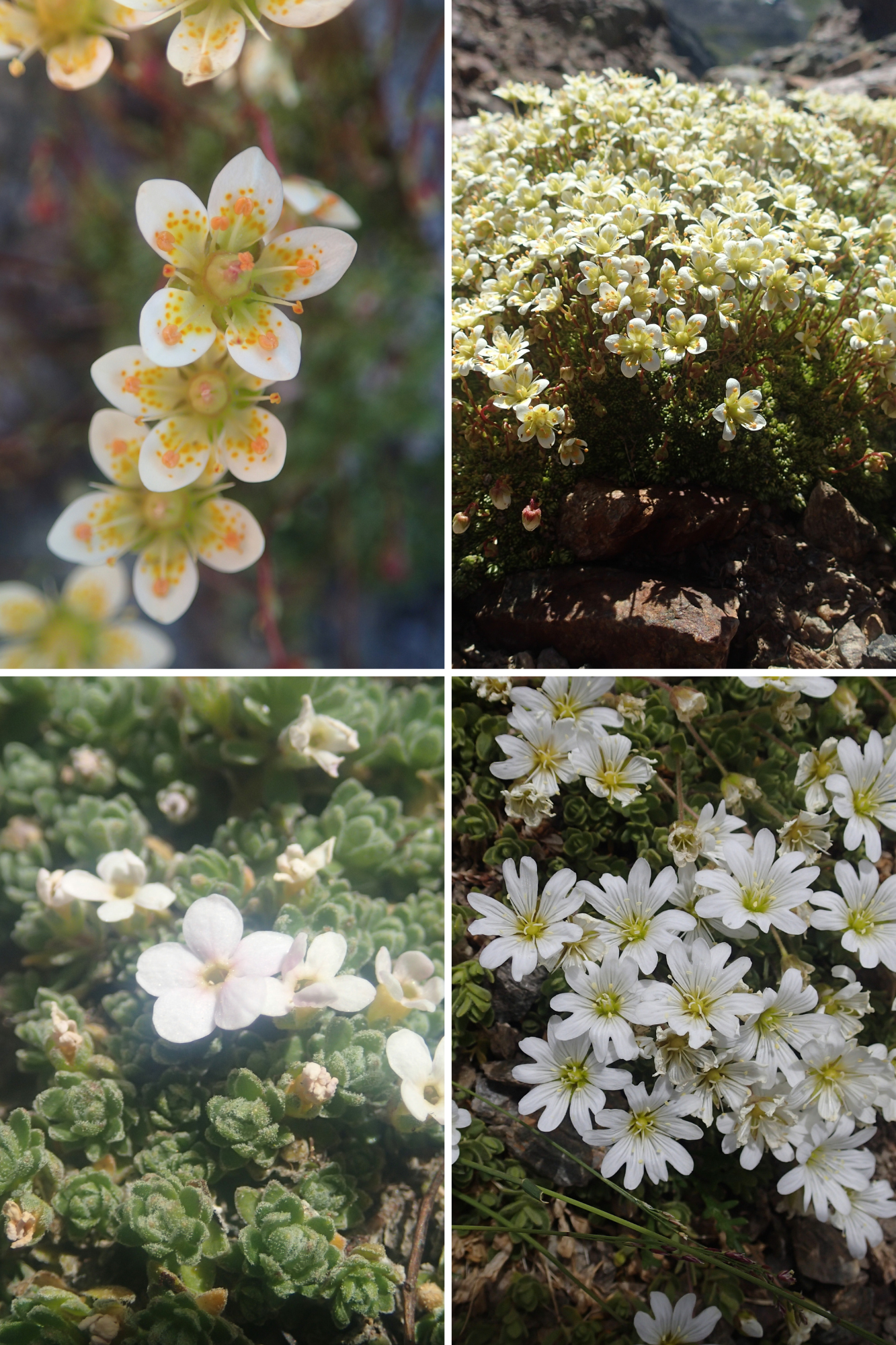
Clockwise from top left; Mossy Saxifrage, Musky Saxifrage, Glacier Mouse-ear and Alpine Rock-jasmine.
At the very highest altitudes, where temperatures are lower and the snow-free period is shorter, even Glacier Crowfoot struggles. Both flower development and the period over which the anthers shed pollen and the stigma is receptive are longer; partly because low temperatures reduce growth rates but also because there are fewer of the appropriate small Muscid and Syrphid fly pollinators around. The proportion of ovules which give rise to mature seed is reduced as a result but, despite this, there is little evidence that the flowers resort to self pollination, as many species do when external pollination seems likely to fail because of harsh conditions.
You might think that a warming climate would allow these lovely plants to extend their range, but work done during the unusually long, warm growing season of 2003 showed that, actually, higher temperatures can cause developmental disorder; when plants flower depends as much on day length as temperature, so plants get mixed messages about what is going on. In addition, Glacier Crowfoot struggles with high temperatures because its respiration rate (particularly important when stored energy is released to maintain the plant at night) goes up rapidly as temperature increases, so that the plant uses up valuable reserves too quickly. Yet another reason to be concerned about our ever-heating world.
- Ida, T.Y., Totland, Ø. Heating effect by perianth retention on developing achenes and implications for seed production in the alpine herb Ranunculus glacialis . Alp Botany 124, 37–47 (2014). https://doi-org.ezphost.dur.ac.uk/10.1007/s00035-014-0129-8
- Wagner, J., Steinacher, G., & Ladinig, U. (2010). Ranunculus glacialis L.: successful reproduction at the altitudinal limits of higher plant life. Protoplasma, 243(1-4), 117–128. https://doi.org/10.1007/s00709-009-0104-1
This week we’re in Scotland, where the food doesn’t always have the healthiest reputation, but we’re enjoying some great beer from the Loch Fyne brewery and the obligatory Tunnock’s snowballs, as part of our well-balanced diet!

I’ve been reading My Husband’s Wife by Alice Feeney – a tense psychological thriller which made for good binge reading on the long train ride home from Switzerland.


Fascinating – I think I noticed Hawthorn stamens changing colour too? Heading for Scotland shortly so looking forward to a dose of Tunnocks best!
Linda M H Fowler
On Mon, 27 Jul 2026, 22:50 heatherkellyblog – travel with me and wonder
Enjoy the wet weather here! Anthers often change colour after they have shed their pollen – you might have noticed that?
Delightful
Thank you!