On our return trip to Tblisi, we’d planned on taking one of the Marshrutkas or shared minibuses which ply popular routes between towns and cities in Georgia but, in the event, with my stomach still unsettled, we asked Saren for a lift again. It’s surprisingly affordable to have someone drive you places – in this case 220 Georgian Lari, or around £60, for a trip of nearly four hours. It also has the advantage that drivers are usually happy to let you make one or two stops en route. Saren suggested taking us to the Green or Mtsvane Monastery, an hour or so’s drive from Akhaltsikhe, on the way to Tblisi and we were glad we’d taken him up on his offer. It’s in a gorgeous, secluded site, in deciduous woodland, a kilometre or two off the main road to Borjomi up a very bumpy track. It would be a lovely place to explore on foot, on the edge of the Borjomi National Park.
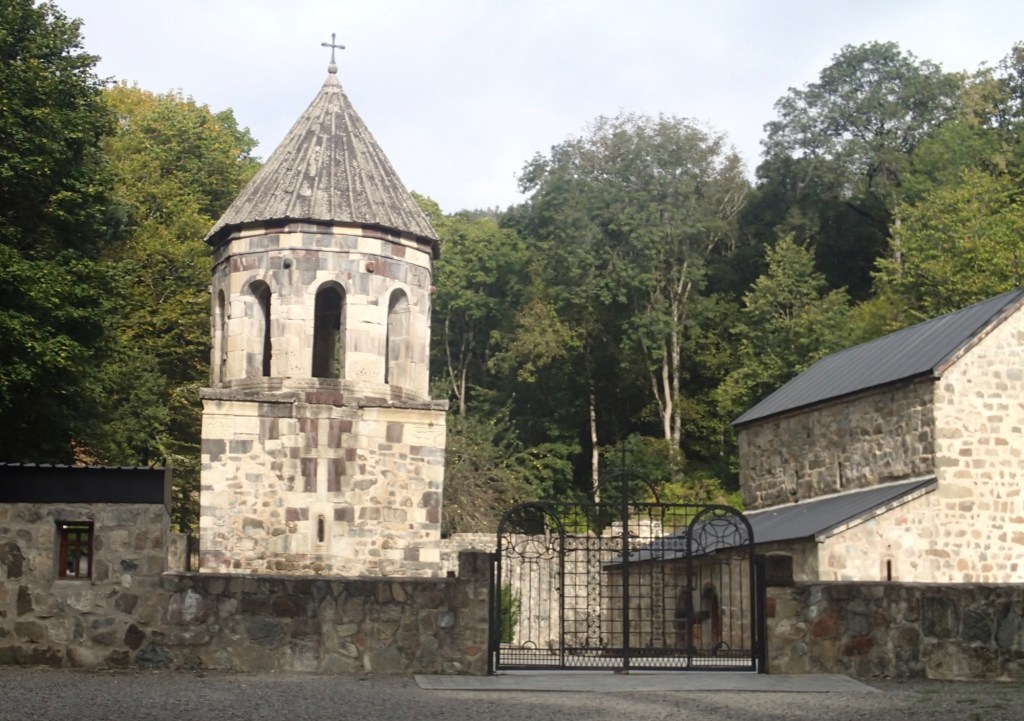
The monastery was founded by Grigol Khandzteli, in the 9th century, and apparently gets its name from the locally-quarried stone used to build it, though I’d not have said it was particularly green. It’s suffered the usual fate hereabouts of being destroyed and rebuilt several times, and was abandoned for nearly 200 years after the whole area became depopulated in the 18th century because of constant fighting between the Ottomans, Georgians and Russians. The process of reclaiming the site from nature and restoring the buildings started in 1978 and the current, small community of monks were installed in 2003.
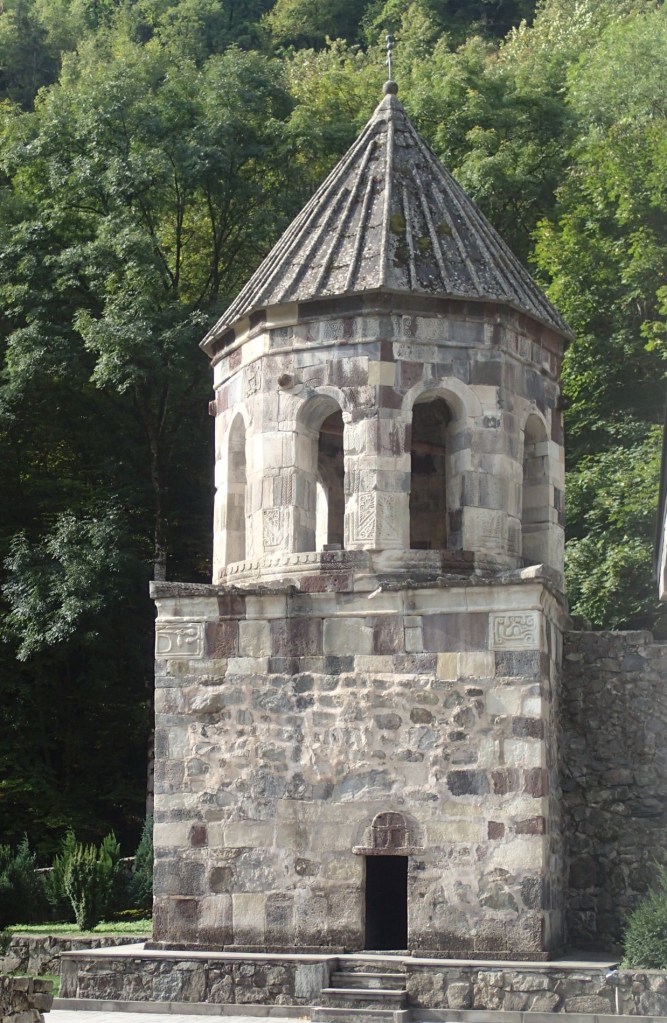
The monastery is now a popular pilgrimage site but we were the first visitors of the day to make it up the bumpy track through the woods. When we arrived, the gate to the complex was closed but unlocked, but the church itself was locked. As we wandered around admiring the detailed exterior carvings on the campanile, a monk appeared and silently unlocked the church for us. Maybe keeping the track in a rough state is no accident – if I were living here I’d be keen to avoid the ‘death by a thousand coach trips’ which Jvari seems to have suffered!
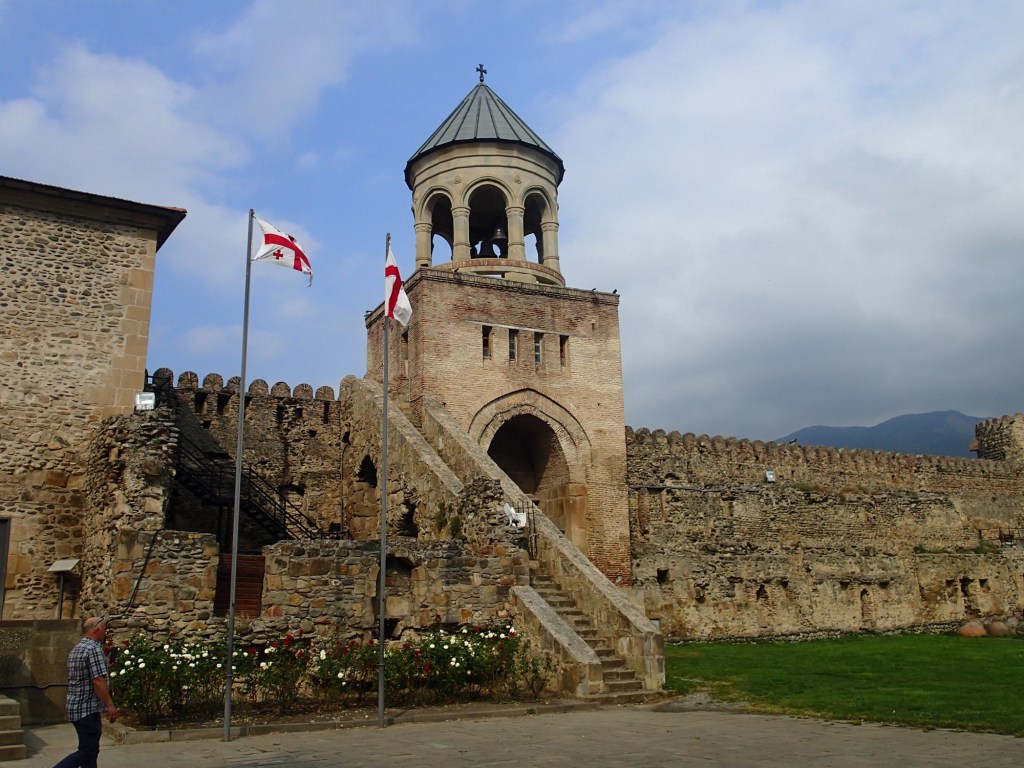
Our final day or two in Tbilisi were marred, for me, by not being able to eat or drink much and being pretty exhausted but we did manage one final excursion, to the famous Svetitskhoveli cathedral in nearby Mtskheta. The cathedral sits on the other side of the confluence of the Kura and Aragvi rivers from Jvari Monastery. Mtskheta is only 25 km from Tblisi but, with the traffic, that doesn’t mean it’s a short journey by taxi… after nearly an hour, we finally arrive. Fortunately, we’re early enough to have beaten most of the big tour groups and the cathedral still feels like a church despite being surrounded by tourist stalls.
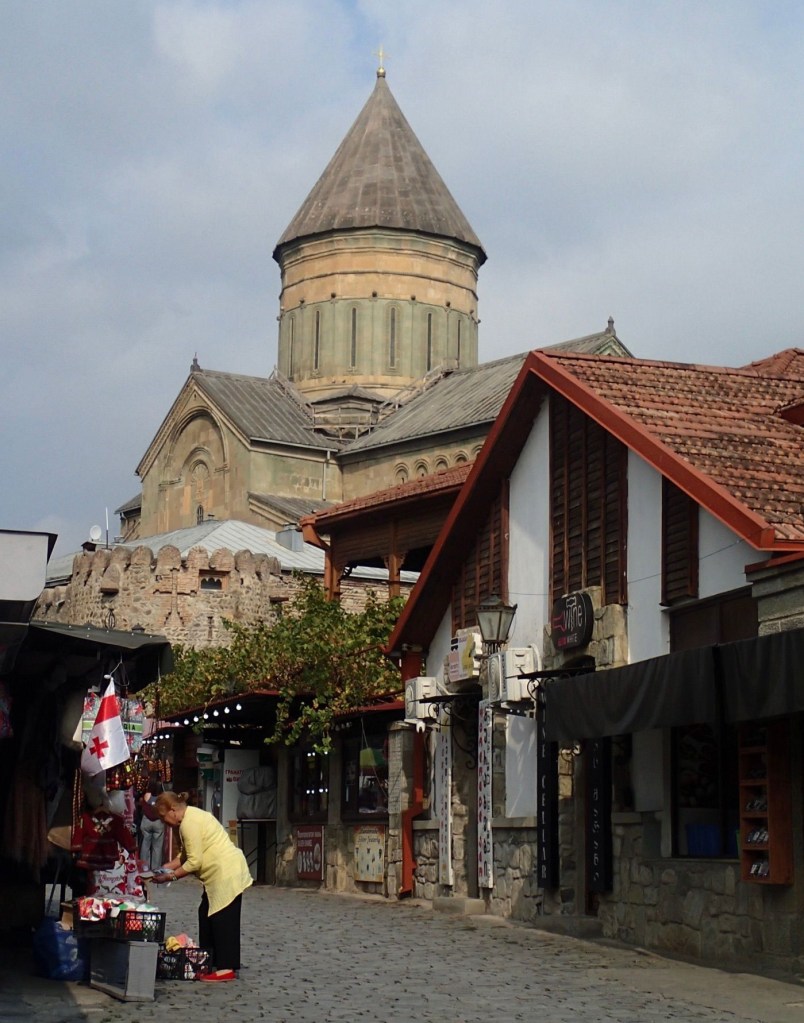
Svetitskhoveli, whose name means ‘life-giving pillar’ is another church with claims to be one of Georgia’s most important and is also UNESCO World Heritage Site. In the 13th century it was considered by some to be the second holiest place in the world and contains a replica of the Church of the Holy Sepulchre in Jerusalem to indicate this. The cathedral is supposed to house Christ’s robe, brought back by a Georgian Jew named Elias who happened to be in Jerusalem at the time of the crucifixion, under one of the main pillars. We puzzled over one of the icons in the cathedral, which seemed to show a levitating tree, cut from its stump and wearing a crown (no photo, unfortunately), but now realise it tells the story of Elias’ sister, Sidonia. She was so overwhelmed when she touched Christ’s robe that she died immediately, and was buried with the robe. An enormous Cedar tree grew from her grave and was cut down by St Nino to make columns for the foundation. One of the columns had miraculous properties, including the ability to levitate, and from it poured a liquid with curative properties – hence the cathedral’s name.
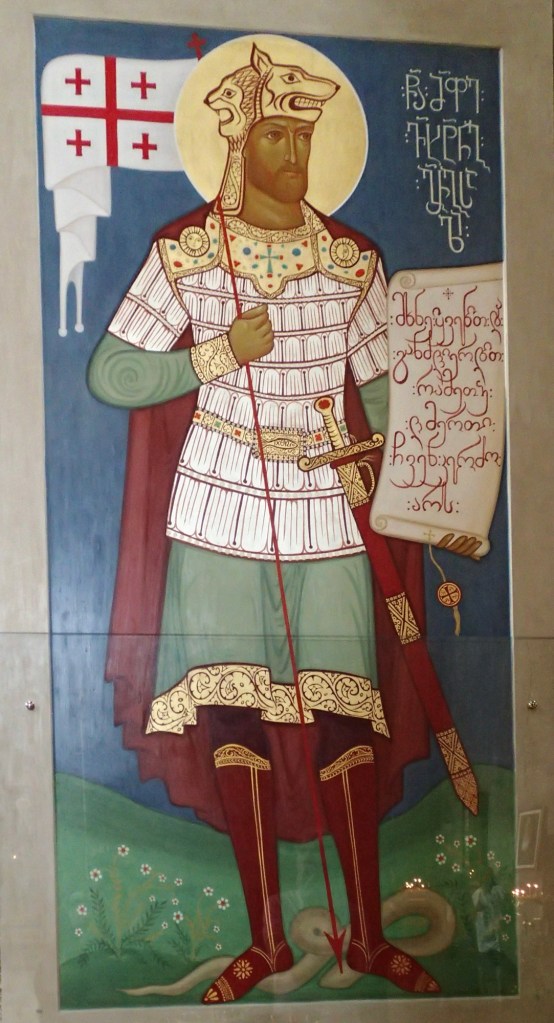
There has been a wooden church here since the fourth century, but the first stone basilica was constructed by King Vakhtang Gorgasali, warrior-king, saint and founder of Tblisi, famous for having a battle helmet with a wolf on the front and a lion on the back. He was entombed here after his death in 502 AD.
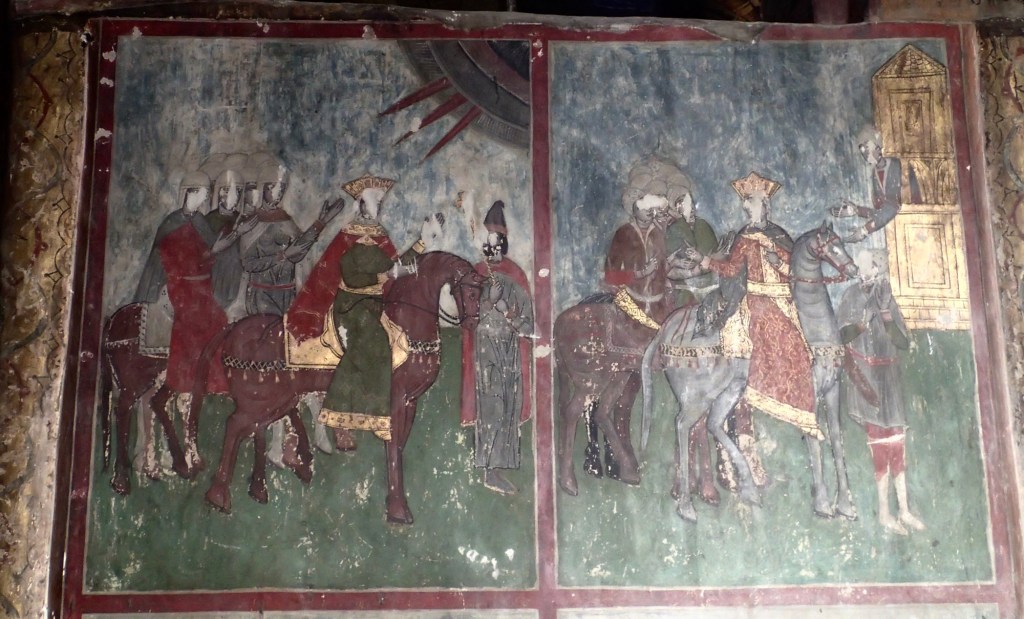
The current stone building was completed around 1020 AD, when Durham cathedral was also being built. Like all churches hereabouts, it’s had more than its fair share of damage and destruction wrought by neighbouring powers and earthquakes over the centuries. The defensive wall of stone and brick built around the cathedral in the late 18th century must have offered a feeling of security but little real protection from Russian Imperial forces bent on whitewashing and defacing its historic frescoes, sadly.
Back in Tblisi, after another long taxi ride which takes us through at least two car park rat runs in a futile attempt to beat the traffic, the best course for me turns out to be spending the afternoon reading about Georgia, rather than being out and about.
I’ve very much enjoyed reading Hard by a Great Forest by Leo Vardiashvili whilst in Georgia. It’s a novel about what happens when a father and his two sons, having fled Tblisi as refugees after the occupation of South Ossetia by Russia in 2008, return years later to try and bury their demons. Much of the novel is set in the Sololaki area of Tblisi where we’ve been based, including the Botanical Gardens, and I’ve enjoyed following the main protagonist, Saba, as he moves around the area searching for clues about what happened to his family. The author himself fled Georgia with his family as a 12 year old, so can paint only too vivid a picture of the trauma of life in the city after the fall of the Soviet Union. The book has also whetted my appetite for another trip to Georgia to explore more of the remote parts of the country, particularly Ushguli where the action at the end of the book plays out. Close to the western edge of South Ossetia and Georgia’s other disputed territory of Abkhazia, it also lies just below Mt Shkhara, the highest peak in the Caucasus. What’s not to like!

