When you tell people you are going to Georgia on holiday, reactions are polarised; either, “wow” or “why”? Those who know how it has sat at the junction of Europe and Asia for centuries, or who’ve watched Michael Portillo’s train journey through the Caucuses or Anthony Bourdain’s ‘Parts Unknown’ on Georgia, get it straight away. For us, it seems to have everything we could hope for; good food and wine, spectacular mountain walking and a rich history of Eastern Orthodox Christianity, with the beautiful monasteries to prove it. My only slight sadness is that the mountain wildflowers with mostly be long over at this time of year but, if we enjoy it as much as we expect to, maybe we’ll come back one spring.
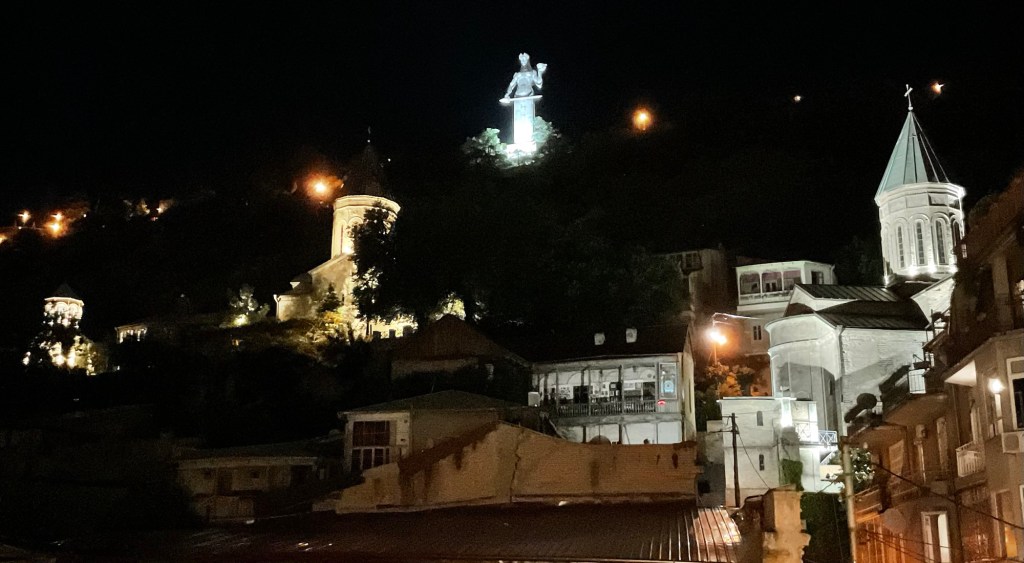
First impressions of Tbilisi are very positive, though the short journey from the airport was painfully slow because of the amount of traffic in the centre of the city. Our hotel, the Strofi Boutique Hotel, is in the heart of old Tbilisi, between the River Kura and the steep hill topped by the Mother of Georgia statue and Narikala fortress and we have a narrow balcony with spectacular views of both, as well as the Upper and Lower Betlemi churches.
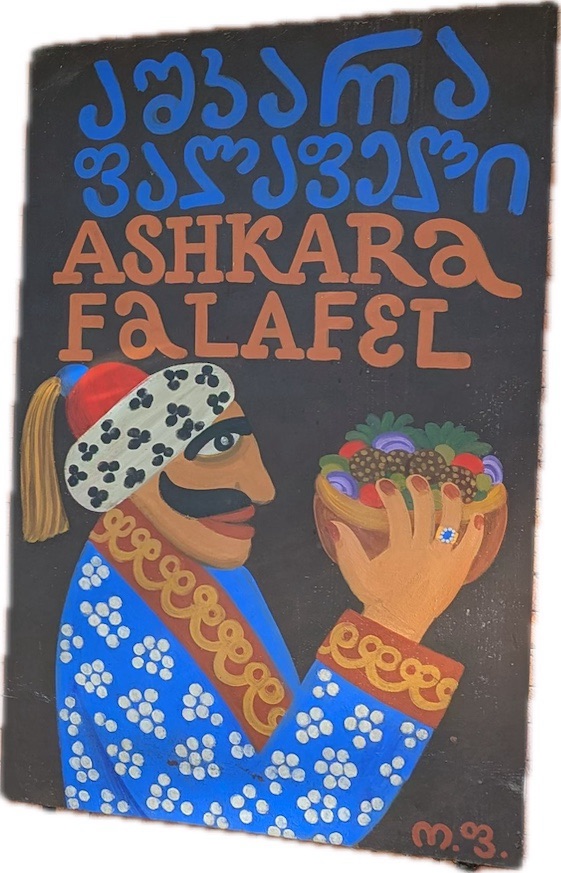
With a three hour time difference from home, it was after 9pm local time when we’d dropped off our bags so we headed for a falafel place Rosie had spotted nearby – an excellent choice, with freshly-cooked falafel and salads, washed down with Georgian wheat beer.
There are plenty of obvious tourists in this part of town but also groups of children playing in the squares, enjoying the evening cool. The ride into the city from the airport was very slow – apparently it’s some sort of holiday and the roads were rammed. Our taxi driver put this down to the local police being more interested in scrolling on Tik-Tok than controlling the traffic. Probably a bit of a simplification, though they did seem to be hanging out chatting to one another in large groups rather than doing anything more dynamic!
As well as a ‘Rough Guide’ to Georgia, Armenia and Azerbaijan, our pre-reading for the trip included the novel Ali and Nino by an author using the pseudonym Kurban Said. Set in Azerbaijan, it’s the Romeo and Juliet for this part of the world and a great introduction to the turbulent history of the Caucuses. Its Georgian Orthodox Christian and Azerbaijani Muslim protagonists, living in Baku in the early years of the 20th century, suffer similarly tragic fates to Shakespeare’s lovers.
My travel reading has been somewhat lighter, though. The Morville Hours, by Katherine Swift, was an inspired birthday present from Harry; the book I’ve most enjoyed reading for a long time. Writing about gardens can be hit and miss but this is so much more than a book on plants; Swift writes beautifully about her garden, lovingly created in a field behind the Dower House at Morville, in rural Shropshire. She bases the book on the pattern of Hours of the Divine Office, which guided the days of prayer and work of the Benedictine monks who once lived in Morville Priory. The monks’ pattern of daily offices was recorded in beautifully illustrated, medieval Books of Hours, which which wa smapped the seasons, both liturgical and meteorological, and following this pattern seems a natural way to tell the story of a garden. As a former librarian of historic texts Swift researches everything meticulously, telling us about the geology and early inhabitants of her corner of Shropshire, as well as the history and mythology of the plants she chooses. H But she wears her erudition lightly, weaving her insights effortlessly into the story of her troubled early life and the garden’s genesis, her sense of wonder at the beauty of the natural world, and the lives of the friends and neighbours who helped create the garden, making the book a delightful read. I will be pressing it on as many of my friends as I can!

